Overview of Static Program Analysis through Abstract Interpretation Techniques
This document discusses static program analysis methods, specifically the use of abstract interpretation. It emphasizes the ability to automatically identify program properties without requiring user-provided loop invariants, while acknowledging that the methods are sound yet incomplete. Abstract interpretation can be precise and applied in various contexts such as compiler optimization, code quality tools, bug identification, and proving the absence of runtime errors. The document also addresses challenges like undecidability and the balance of soundness versus precision in analysis.

Overview of Static Program Analysis through Abstract Interpretation Techniques
E N D
Presentation Transcript
Program analysis Mooly Sagiv html://www.cs.tau.ac.il/~msagiv/courses/wcc10.html
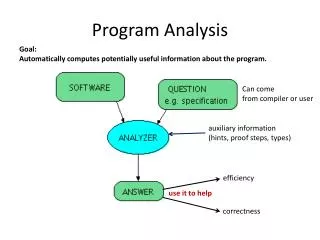
Abstract InterpretationStatic analysis • Automatically identify program properties • No user provided loop invariants • Sound but incomplete methods • But can be rather precise • Non-standard interpretation of the program operational semantics • Applications • Compiler optimization • Code quality tools • Identify potential bugs • Prove the absence of runtime errors • Partial correctness
Control Flow Graph(CFG) z = 3 while (x>0) { if (x = 1) y = 7; else y =z + 4; assert y == 7 } z =3 while (x>0) if (x=1) y =7 y =z+4 assert y==7
Constant Propagation [x?, y?, z?] z =3 [x?, y?, z 3] [x?, y?, z3] while (x>0) [x?, y?, z3] if (x=1) [x?, y?, z3] [x1, y?, z3] y =7 y =z+4 [x1, y7, z3] [x?, y7, z3] assert y==7
potential leakage of address pointed to by head Memory Leakage List reverse(Element head) { List rev, n;rev = NULL; while (head != NULL) { n = head next; head next = rev; head = n; rev = head; }return rev; }
Memory Leakage Element reverse(Element head) { Element rev, n;rev = NULL; while (head != NULL) { n = head next; head next = rev; rev = head; head = n; }return rev; } • No memory leaks
Potential buffer overrun: offset(s) alloc(base(s)) A Simple Example void foo(char *s ) { while ( *s != ‘ ‘ ) s++; *s = 0; }
A Simple Example void foo(char *s) @require string(s) { while ( *s != ‘ ‘&& *s != 0) s++; *s = 0; } • No buffer overruns
Example Static Analysis Problem • Find variables which are live at a given program location • Used before set on some execution paths from the current program point
a b c A Simple Example c /* c */ L0: a := 0 /* ac */ L1: b := a + 1 /* bc */ c := c + b /* bc */ a := b * 2 /* ac */ if c < N goto L1 /* c */ return c a:=0 ac b:=a+1 bc c := c +b bc a := b * 2 ac T c < N F c return c
source-program Compiler Scheme Scanner String tokens Parser Tokens AST Semantic Analysis Code Generator IR Static analysis IR +information Transformations
Undecidability issues • It is impossible to compute exact static information • Finding if a program point is reachable • Difficulty of interesting data properties
Undecidabily • A variable is live at a givenpoint in the program • if its current value is used after this point prior to a definition in some execution path • It is undecidable if a variable is live at a given program location
Proof Sketch Pr L: x := y Is y live at L?
Conservative (Sound) • The compiler need not generate the optimal code • Can use more registers (“spill code”) than necessary • Find an upper approximation of the live variables • Err on the safe side • A superset of edges in the interference graph • Not too many superfluous live variables
Conservative(Sound) Software Quality Tools • Can never miss an error • But may produce false alarms • Warning on non existing errors
Data Flow Values • Order data flow values • a b a “is more precise than” b • In live variables • a b a b • In constant propagation • a b a includes more constants than b • Compute the least solution • Merge control flow paths optimistically • a b • In live variables • a b= ab
Transfer Functions • Program statements operate on data flow values conservatively
Transfer Functions (Constant Propagation) • Program statements operate on data flow values conservatively • If a=3 and b=7 before “z = a + b;” • then a=3, b =7, and z =10 after • If a=? and b=7 before “z = a + b;” • then a=?, b =7, and z =? After • For x = exp • CpOut = CpIn [x [[exp]](CpIn)]
Transfer FunctionsLiveVariables • If a and c are potentially live after “a = b *2” • then b and c are potentially live before • For “x = exp;” • LiveIn = Livout – {x} arg(exp)
Iterative computation of conservative static information • Construct a control flow graph(CFG) • Optimistically start with the best value at every node • “Interpret” every statement in a conservative way • Forward/Backward traversal of CFG • Stop when no changes occur
Pseudo Code (forward) forward(G(V, E): CFG, start: CFG node, initial: value){ // initialization value[start]:= initial for each v V – {start} do value[v] := // iteration WL = V while WL != {} do select and remove a node v WL for each u V such that (v, u) E do value[u] := value[u] f(v, u)(value[v]) if value[u] was changed WL := WL {u}
Constant Propagation 1: z =3 2: while (x>0) 3: if (x=1) 4: y =7 5: y =z+4 Only values before CFG are shown
Pseudo Code (backward) backward(G(V, E): CFG, exit: CFG node, initial: value){ // initialization value[exit]:= initial for each v V – {exit} do value[v] := // iteration WL = V while WL != {} do select and remove a node v WL for each u V such that (u, v) E do value[u] := value[u] f(v, u)(value[v]) if value[u] was changed WL := WL {u}
a := 0 ; /* c */ L0: a := 0 /* ac */ L1: b := a + 1 /* bc */ c := c + b /* bc */ a := b * 2 /* ac */ if c < N goto L1 /* c */ return c b := a +1 ; c := c +b ; a := b*2 ; c <N goto L1 return c ;
a := 0 ; b := a +1 ; c := c +b ; a := b*2 ; c <N goto L1 return c ;
a := 0 ; b := a +1 ; c := c +b ; a := b*2 ; c <N goto L1 {c} return c ;
a := 0 ; b := a +1 ; c := c +b ; a := b*2 ; {c} c <N goto L1 {c} return c ;
a := 0 ; b := a +1 ; c := c +b ; {c, b} a := b*2 ; {c} c <N goto L1 {c} return c ;
a := 0 ; b := a +1 ; {c, b} c := c +b ; {c, b} a := b*2 ; {c} c <N goto L1 {c} return c ;
a := 0 ; {c, a} b := a +1 ; {c, b} c := c +b ; {c, b} a := b*2 ; {c} c <N goto L1 {c} return c ;
a := 0 ; {c, a} b := a +1 ; {c, b} c := c +b ; {c, b} a := b*2 ; {c, a} c <N goto L1 {c, a} return c ;
Summary Iterative Procedure • Analyze one procedure at a time • More precise solutions exit • Construct a control flow graph for the procedure • Initializes the values at every node to the most optimistic value • Iterate until convergence
Abstract Interpretation • The mathematical foundations of program analysis • Established by Cousot and Cousot 1979 • Relates static and runtime values
Operational semantics statement s Set of states Set of states concretization abstraction statement s abstract representation Abstract semantics Abstract (Conservative) interpretation abstract representation
Example rule of signs • Safely identify the sign of variables at every program location • Abstract representation {P, N, ?} • Abstract (conservative) semantics of *
Operational semantics x := x*y {…, <176, -2>…} {…,<-88, -2>,…} concretization abstraction x := x*#y <P, N> Abstract semantics Abstract (conservative) interpretation <N, N>
Example rule of signs • Safely identify the sign of variables at every program location • Abstract representation {P, N, ?} • (C) = if all elements in C are positive then return P else if all elements in C are negative then return N else return ? • (a) = if (a==P) then return{0, 1, 2, … } else if (a==N) return {-1, -2, -3, …, } else return Z
Example Constant Propagation • Abstract representation • set of integer values and and extra value “?” denoting variables not known to be constants • Conservative interpretation of +
Example Program x = 5; y = 7; if (getc()) y = x + 2; z = x +y;
Example Program (2) if (getc()) x= 3 ; y = 2; else x =2; y = 3; z = x +y;
Operational semantics statement concretization concretization statement# Abstract semantics Local Soundness of Abstract Interpretation
Operational semantics statement statement# Abstract semantics Local Soundness of Abstract Interpretation abstraction abstraction
Some Success StoriesSoftware Quality Tools • The prefix Tool identified interesting bugs in Windows • The Microsoft SLAM tool checks correctness of device driver • Driver correctness rules • Astree checks floating point operation
Summary • Program analysis provides non-trivial insights on the runtime executions of the program • Degenerate case – types (flow insensitive) • Mathematically justified • Operational semantics • Abstract interpretation (lattice theory) • Employed in compilers • Will be employed in software quality tools