Download
1 / 3
0 likes | 1 Views
Understand the key differences between a summary and a synopsis in academic writing. Learn how summaries provide brief overviews while synopses offer comprehensive structured research presentations. Writing Tree provides professional synopsis writing services for thesis submissions, ensuring your research meets university guidelines with clarity and academic excellence. https://writingtree.in/synopsis-writing/

E N D
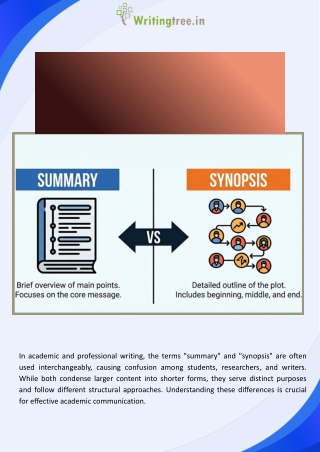
What is the Difference Between a Summary and a Synopsis? In academic and professional writing, the terms "summary" and "synopsis" are often used interchangeably, causing confusion among students, researchers, and writers. While both condense larger content into shorter forms, they serve distinct purposes and follow different structural approaches. Understanding these differences is crucial for effective academic communication.
Understanding a Summary A summary is a brief overview that captures the main points, key arguments, and essential information from a larger text. It presents ideas in a condensed format without personal interpretation or critical analysis. Summaries typically follow the original document's structure chronologically, highlighting important facts, findings, and conclusions. Summaries are commonly used in literature reviews, research paper abstracts, executive reports, and book reviews. They can vary in length from a few sentences to several paragraphs, depending on the original content's complexity and purpose. The primary goal is informing readers about core content without requiring them to read the entire document. Understanding a Synopsis A synopsis is a comprehensive, structured overview that not only summarizes content but also provides context, methodology, and significance. Unlike summaries, synopses often include background information, research objectives, methodology overview, key findings, implications, and conclusions in a structured format. In academic contexts, particularly for thesis and dissertation submissions, synopses serve as standalone documents that help evaluation committees understand the complete research scope. They typically range from 500 to 3000 words and follow specific formatting guidelines set by universities or publishers. Key Differences Length: Summaries are generally shorter; synopses are more detailed and comprehensive. Structure: Summaries follow the original content's flow; synopses use standardized academic formats with specific sections. Purpose: Summaries provide quick overviews; synopses serve as formal academic or professional documents for evaluation. Content Depth: Summaries highlight main points; synopses include methodology, theoretical frameworks, and research significance. Call us : +916264689448 www.writingtree.in
Professional Synopsis Writing Services Creating an effective synopsis requires expertise in academic writing conventions, research methodology, and disciplinary standards. Many doctoral candidates and researchers struggle with structuring synopses that meet university requirements while effectively communicating their research contribution. Synopsis writing services provide expert assistance in crafting comprehensive, well-structured synopses that adhere to institutional guidelines. Writing Tree offers professional synopsis writing services with PhD-qualified writers who understand academic formatting, research presentation, and evaluation criteria across disciplines. Our synopsis writing services ensure your research is presented clearly, professionally, and persuasively, whether for thesis submission, funding applications, or publication proposals. Writing Tree | Expert Synopsis Writing Services writingtree Call us : +916264689448 www.writingtree.in