Disorderly Distributed Programming: Exploring the Bloom Language and Its Concepts
This document presents an overview of disorderly distributed programming, focusing on the Bloom language developed by researchers at UC Berkeley and Portland State University. It highlights the challenges of writing order-sensitive programs in distributed systems and explores three alternatives to tackle these issues. The Bloom language encourages order-independent programming by default, allowing developers to define behavior without being constrained by event order. With insights into consistency as logical monotonicity and various operational models, Bloom paves the way for easier management of distributed applications.

Disorderly Distributed Programming: Exploring the Bloom Language and Its Concepts
E N D
Presentation Transcript
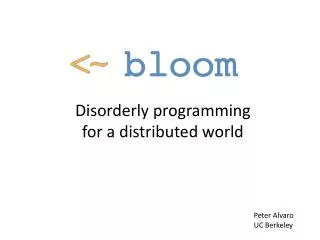
Disorderly Distributed Programming with Bloom Emily Andrews, Peter Alvaro, Peter Bailis,Neil Conway, Joseph M. Hellerstein,William R. Marczak UC Berkeley David Maier Portland State University
Problem: Different nodes might perceivedifferent event orders
Taking Order For Granted Writing order-sensitiveprograms is too easy!
Alternative #1: • Enforce consistent event order at all nodes • Extensive literature: • Replicated state machines • Consensus, coordination • Group communication • “Strong Consistency”
Alternative #1: • Enforce consistent event order at all nodes • Problems: • Latency • Availability
Alternative #2: Analyze all event orders,ensure correct behavior
Alternative #2: Analyze all event orders to ensure correct behavior Problem: That is really,really hard
Alternative #3: Write order-independent (“disorderly”) programs
Alternative #3: • Write order-independent (“disorderly”) programs • Questions: • How to write such programs? • What can we express in a disorderly way?
Disorderly Programming • Program analysis: CALM • Where is order needed? And why? • Language design: Bloom • Order-independent by default • Ordering is possible but explicit • Mixing order and disorder: Blazes • Order synthesis and optimization • Algebraic programming
CALM: Consistency As Logical Monotonicity
History • Roots in UCB database research (~2005) • High-level, declarative languages for network protocols & distributed systems • “Small programsfor large clusters” (BOOM) • Distributed programming with logic • State: sets (relations) • Computation: deductive rules over sets • SQL, Datalog, etc.
Observation: Much of Datalog isorder-independent.
Monotonic Logic • As input set grows, output set does not shrink • “Mistake-free” • Order independent • e.g., map, filter, join, union, intersection Non-Monotonic Logic • New inputs might invalidate previous outputs • Order sensitive • e.g., aggregation, negation
Agents learn strictly more knowledge over time Different learning order, same final outcome Deterministic outcome, despite network non-determinism (“Confluent”)
CALM Analysis (CIDR’11) Monotone programs are deterministic Simple syntactic test for monotonicity Result: Whole-program static analysis foreventual consistency ConsistencyAs LogicalMonotonicity
CALM: Beyond Sets • Monotonic logic: growing sets • Partial order: set containment • Expressive but sometimes awkward • Timestamps, version numbers, threshold tests, directories, sequences, …
Challenge: Extend monotone logic tosupport other flavors of “growth over time”
hS,t,?iis a bounded join semilatticeiff: • S is a set • t is a binary operator (“least upper bound”) • Induces a partial order on S: x·Sy if xty = y • Associative, Commutative, and Idempotent • “ACID 2.0” • Informally, LUB is “merge function” for S • ? is the “least” element in S • 8x2S: ?t x= x
Time Set(t = Union) Increasing Int(t = Max) Boolean(t = Or)
f: ST is a monotone function iff: 8a,b2S : a·Sb) f(a)·Tf(b)
Time Monotone function:set increase-int Monotone function:increase-intboolean size() >= 3 Set(t = Union) Increasing Int(t = Max) Boolean(t = Or)
The BloomProgramming Language
Quorum Vote QUORUM_SIZE=5 RESULT_ADDR="example.org" classQuorumVote includeBud state do channel :vote_chn, [:@addr, :voter_id] channel :result_chn, [:@addr] lset:votes lmax:vote_cnt lbool:got_quorum end bloom do votes <=vote_chn {|v|v.voter_id} vote_cnt<=votes.size got_quorum<=vote_cnt.gt_eq(QUORUM_SIZE) result_chn<~got_quorum.when_true { [RESULT_ADDR] } end end Annotated Ruby class Communication interfaces:non-deterministic delivery order! Program state Lattice state declarations Accumulate votesinto set Merge at non-deterministicfuture time Monotone function: set max Monotone function: max bool Program logic Merge new votes togetherwith stored votes (set LUB) Merge using lmax LUB Threshold test on bool (monotone)
Some Features of Bloom • Library of built-in lattice types • Booleans, increasing/decreasing integers, sets, multisets, maps, sequences, … • API for defining custom lattice types • Support both relational-style rules and functions over lattices • Model-theoretic semantics (“Dedalus”) • Logic + state update + async messaging
Ongoing Work Runtime • Current implementation: Ruby DSL • Next generation: JavaScript, code generation • Also target JVM, CLR, MapReduce Tools • BloomUnit: Distributed testing / debugging • Verification of lattice type implementations Software stack • Concurrent editing, version control • Geo-replicated consistency control
CRDTs vs. Bloom Similarities • Focus on commutative operations • Formalized via join semilattices • Monotone functions composition of CRDTs • Similar design patterns (e.g., need for GC) Differences • Approach: language design vs. ADTs • Correctness: confluence vs. convergence • Confluence is strictly stronger • CRDT “query” is not necessarily monotone • CRDTs more expressive?
Ongoing Work Runtime • Current implementation: Ruby DSL • Next generation: JavaScript, code generation • Also target JVM, CLR, MapReduce Tools • BloomUnit: Distributed testing / debugging • Verification of lattice type implementations Software stack • Built: Paxos, HDFS, 2PC, lock manager, causal delivery, distributed ML, shopping carts, routing, task scheduling, etc. • Working on: • Concurrent editing, version control • Geo-replicated consistency control
Blazes: Intelligent Coordination Synthesis
Mixing Order and Disorder • Can these ideas scale to large systems? • Ordering can rarely be avoided entirely • Make order part of the design process • Annotate modules with ordering semantics • If needed, coordinate at module boundaries • Philosophy • Start with what we’re given (disorder) • Create only what we need (order)
Tool Support • Path analysis • How does disorder flow through a program? • Persistent vs. transient divergence • Coordination synthesis • Add “missing” coordination logic automatically
Coordination Synthesis • Coordination is costly • Help programmers use it wisely! • Automatic synthesis of coordination logic • Customize coordination code to match: • Application semantics (logical) • Network topology (physical)
Application Semantics • Common pattern: “sessions” • (Mostly) independent, finite duration • During a session: • Only coordinate among participants • After a session: • Session contents are sealed (immutable) • Coordination is unnecessary!
Sealing • Non-monotonicity arbitrary change • Very conservative! • Common pattern in practice: • Mutable for a short period • Immutable forever after • Example: bank accounts at end-of-day • Example: distributed GC • Once (global) refcount = 0, remains 0
Affinity • Network structure affects coordination cost • Example: • m clients, n storage servers • 1 client request many storage messages • Possible strategies: • Coordinate among (slow?) clients • Coordinate among (fast?) servers • Related: geo-replication, intra- vs. inter-DC coordination, “sticky” sessions
Algebraic Programming
Adversarial Programming • A confluent program must behave correctly for any network schedule • Network as “adversary” • What if we could control the network? • Schedule only influences performance,not correctness • Sounds like an optimizer!
Algebra vs. Ordering The developer writes two programs: • Algebra defines program behavior • Guaranteed to be order independent • Language: high-level, declarative • Ordering Spec controls input order • Ordering, batching, timing • Language: arbitrary (e.g., imperative) • Need not be deterministic
Benefits • Separate correctness and performance • Might be developed independently! • Wide range of freedom for optimization • No risk of harming correctness • Randomness, batching, parallelism,CPU affinity, data locality, … • Auto-tuning/synthesis of ordering spec?
Examples Quicksort Algebra: • Input: values to sort, pivot elements • Output: sorted list Ordering Spec: • Ordering of pivots Matrix Multiplication Algebra: • Input: sub-matrices • Output: result of matrix multiply Ordering Spec: • Tiling • i.e., division of input matrices into pieces
In a distributed system, Order is precious! Let’s stop taking it for granted.
Recap • The network is disorderly – embrace it! • How can we write disorderly programs? • State: join semilattices • Computation: monotone functions • When order is necessary, use it wisely • A program’s ordering requirements should be a first-class concern!
Thank You! Questions Welcome