Sockets Programming in Linux
This guide covers the essential aspects of socket programming in Linux, including the creation and management of TCP and UDP clients and servers. Learn how to create sockets, bind them to ports, listen for incoming connections, and handle messages. Explore essential socket API functions with examples, illustrating how to implement a client-server architecture. This resource serves as a reference for developers looking to understand the intricacies of UNIX network programming while providing practical examples to implement in their projects.

Sockets Programming in Linux
E N D
Presentation Transcript
Sockets Programming in Linux References: Internetworking with TCP/IP Vol III - Linux version UNIX Network Programming - W. Richard Stevens
Sockets Programming in Linux • Linux / UNIX Socket API functions • Example TCP / UDP Clients • Example TCP / UDP Servers
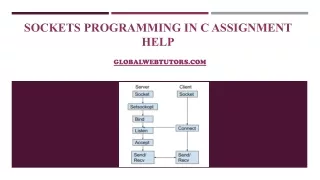
Basic Socket FunctionsServer(Linux / UNIX) • Create a socket of a particular type • retcode = socket (family, type, protocol ) • s = socket (PF_INET, SOCK_STREAM, 0) • returns socket number or -1 on error • Bind that socket to a specific port • retcode = bind (socket, localaddr, addrlen ) • n = bind (s, (struct sockaddr *)myaddr, sizeof(myaddr)) • returns 0 on success, -1 on fail
Basic Socket FunctionsServer(Linux / UNIX) • Wait for an incoming message • retcode = listen (socket, queuelen) • ans = listen(s, 0) /* queuelen max ~ 5*/ • return value 0 = success, -1 = fail • Create a new socket and return new socket ID to client • retcode = accept (socket, addr, addrlen) • ans = accept (s, (struct sockaddr *)cl_addr, sizeof(cl_addr)) • return value socket number = success, -1 = fail
Basic Socket Functions Server (Linux / UNIX) • Read / send a message • retcode = read [write] (socket, buff, bufflen) • ans = read (s, buf, sizeof(buf)) • ans = write (s, buf, sizeof(buf)) • return value word count = success, -1 = fail • retcode = recv [send] (socket, buff, bufflen, 0) • ans = recv (s, buf, sizeof(buf), 0) • ans = send (s, buf, sizeof(buf), 0) • return value word count = success, -1 = fail • Close the socket • retcode = shutdown (socket , direction) • direction: 0 means input, 1 means output, 2 means both • retcode = close (socket ) • return value 0 = success, -1 = fail
Basic Socket FunctionsClient (Linux / UNIX) • Create a socket of a particular type • Socket ( ) • Establish a connection to a remote Port/Socket • retcode = connect (socket, addr, addrlen) • ans = connect (s, (struct sockaddr *)&svr, sizeof(svr)) • return value 0 = success, -1 = fail • Send and receive messages to/from remote socket • Read( ) / Write( ) of recv( ) / send( • Close the socket • Close ( )
Additional Socket Functions(Linux / UNIX) • Byte ordering functions • servaddr.sin_port = htons (SERV_PORT) • myaddr.sin_addr.s_addr = htonl (INADDR_ANY) • Name resolution functions • host / protocol / service, by name / address / port • Other Stuff • zero out memory blocks • bzero ((char *)&myaddr, sizeof(myaddr)); • copy memory blocks • bcopy (hp->h_addr, (caddr_T)&svaddr.sin_addr, hp->h_length)
Example Linux Client • Develop a set of procedures that can be used by other programs to implement client / server. int connectTCP (host, service) int connectsock(host, service, “tcp”) [identify service, host, port] [get a socket] [connect to service / host / port] [return socket number]
Linux Client - Connectsock.c int connectTCP (char *host, char *service) { return connectsock (host, service, “tcp”); }
Linux Client - Connectsock.c #include <sys/types.h>, <sys/socket.h>, <netinet/in.h>,<netdb.h> int connectsock (char *host, char *service, char *protocol) { struct hostent *phe; struct servent *pse; struct protoent *ppe; struct sockaddr_in sin; int s, type;
Linux Client - Connectsock.c bzero ((char *)&sin, sizeof (sin)); sin.sin_family = AF_INET; if (pse = getservbyname (service, protocol) ) sin.sin_port = pse ->s_port; else if ( (sin.sin_port = htons((u_short)atoi(service))) == 0) error_exit (“can’t get %s service\n”, service); if (phe = gethostbyname (host) ) bcopy(phe->h_addr, (char *)&sin.sin_addr, phe->h_length); else if ((sin.sin_addr.s_addr = inet_addr(host)) == INADDR_NONE) error_exit (“can’t get %s host\n”, host);
Linux Client - Connectsock.c if ( (ppe = getprotobyname (protocol) == 0) error_exit (“can’t get %s host\n”, host); if (strcmp (protocol, “tcp”) == 0) type = SOCK_STREAM; else type = SOCK_DGRAM; if (s = socket (PF_INET, type, ppe->p_proto)) < 0) error_exit (“Can’t create a socket\n”); if (connect (s, (struct sockaddr *)&sin, sizeof(sin)) < 0) error_exit (“can’t connect to remote socket\n”); return s; }
Example Linux Client - TCPecho.c #include <stdio.h> #define LINELEN 128 int main (argc, argv) { host = argv[1]; service = argv[2]; TCPecho (host, service); exit (0); }
Example Linux Client - TCPecho.c int TCPecho (char *host, char *service) { char buf[LINELEN+1]; int s, n, outchars, inchars; s = connectTCP (host, service); while (fgets (buf, sizeof(buf), stdin)) { buf[LINELEN] = ‘\0’; outchars = strlen(buf); (void) write (s, buf, outchars);
Example Linux Client - TCPecho.c for (inchars = 0; inchars < outchars; inchars +=n) { n = read (s, &buf[inchars], outchars - inchars); if (n < 0) error_exit(“socket read failed\n”); } fputs (buf, stdout); } }
TCP Client Algorithm Issues • Client / Server Communications • request / response interaction • write / read (send / recv) • Single write may require multiple reads • response may be segmented • continue appending reads until return length = 0
Example Linux Client - UDPecho.c #include <stdio.h> #define LINELEN 128 int main (argc, argv) { host = argv[1]; service = argv[2]; UDPecho (host, service); exit (0); }
Example Linux Client - UDPecho.c int UDPecho (char *host, char *service) { char buf[LINELEN+1]; int s, n, outchars, inchars; s = connectUDP (host, service); while (fgets (buf, sizeof(buf), stdin)) { buf[LINELEN] = ‘\0’; outchars = strlen(buf); (void) write (s, buf, outchars);
Example Linux Client - UDPecho.c if (read (s, buf, nchars) < 0) error_exit (“Socket read failed \n”); fputs (buf, stdout); } }
Iterative Connectionless ServerTIME Server /* UDPtimed.c - main */ #include <sys/types.h> #include <sys/socket.h> #include <netinet/in.h> #include <stdio.h> #include <time.h> #include <string.h> extern int errno; int passiveUDP(const char *service); int errexit(const char *format, ...); #define UNIXEPOCH 2208988800 /* UNIX epoch, in secs*/
Iterative Connectionless ServerTIME Server int main(int argc, char *argv[]) { struct sockaddr_in fsin; /* the address of a client */ char * service = "time"; /* service name or port number */ char buf[1]; /* "input" buffer; any size > 0 */ int sock; /* server socket */ time_t now; /* current time */ int alen; /* from-address length */ switch (argc) { case 1: break; case 2: service = argv[1]; break; default: errexit("usage: UDPtimed [port]\n"); }
Iterative Connectionless ServerTIME Server sock = passiveUDP(service); while (1) { alen = sizeof(fsin); if (recvfrom(sock, buf, sizeof(buf), 0, (struct sockaddr *)&fsin, &alen) < 0) errexit("recvfrom: %s\n", strerror(errno)); (void) time(&now); now = htonl((u_long)(now + UNIXEPOCH)); (void) sendto(sock, (char *)&now, sizeof(now), 0, (struct sockaddr *)&fsin, sizeof(fsin)); } }
Concurrent Connection-OrientedTCPechod.c #include <sys/types.h, <sys/signal.h, <sys/socket.h, <sys/time.h, <sys/resource.h, <sys/wait.h, <sys/errno.h, <netinet/in.h>, <pthread.h>, <unistd.h>, <stdlib.h>, <stdio.h>, <string.h>, <errno.h> #define QLEN 10 /* max connect queue length*/ #define BUFSIZE 4096 extern int errno; void * TCPechod(void *pfd); int errexit(const char *format, ...); int passiveTCP(const char *service, int qlen);
Concurrent Connection-OrientedTCPechod.c int main(int argc, char *argv[]) { char *service = "echo"; /* service name/port #*/ struct sockaddr_in fsin; /* address of client*/ unsigned int alen; /* len of client addr*/ int msock; /* master server socket */ int ssock; /* slave server socket */ pthread_t tid; switch (argc) { case 1: break; case 2: service = argv[1]; break; default: errexit("usage: TCPechod [port]\n"); }
Concurrent Connection-OrientedTCPechod.c msock = passiveTCP(service, QLEN); while (1) { alen = sizeof(fsin); ssock = accept (msock, (struct sockaddr *)&fsin, &alen); if (ssock < 0) { errexit("accept: %s\n", strerror(errno)); } //Now create a thread to handle client request pthread_create (&tid, NULL, &TCPechod, (void *)&ssock); } //end of while }//end of main
Concurrent Connection-OrientedTCPechod.c msock = passiveTCP(service, QLEN); while (1) { alen = sizeof(fsin); ssock = accept(msock, (struct sockaddr *)&fsin, &alen); if (ssock < 0) { errexit("accept: %s\n", strerror(errno)); } //Now create a thread to handle client request pthread_create (&tid, NULL, &TCPechod, (void *)&ssock); } //end of while }//end of main
Concurrent Connection-OrientedTCPechod.c void * TCPechod(void * pfd) { char buf[BUFSIZE]; int cc, fd; fd = * (int *) pfd; while (cc = recv(fd, buf, sizeof (buf), 0)) { if (cc < 0) errexit("echo read: %s\n", strerror(errno)); printf ("We got: %s\n", buf); if (send(fd, buf, cc, 0) < 0) errexit("echo write: %s\n", strerror(errno)); bzero (&buf, sizeof(buf)); } }
Summary • Sockets API almost identical in Windows and Linux • Linux does not use WSAStartup, WSACleanup • Linux uses close(socket), Windows uses closesocket() • Some differences in Operating System functions • Multiple threads • Windows - _beginthread (…) • Linux – pthread_create (…) • Multiple Processes • Windows – CreateProcess(…) • Linux – Fork()