Exploring Context-Free Grammars and Turing Machines: Anbncn Language Examination
This text delves into context-free grammars (CFGs) and Turing machines, focusing on the language {anbncn | n ≥ 0}. It presents Theorem 2.34, which reflects the pumping lemma for context-free languages, outlining conditions for language acceptance. The proof concept highlights surgical operations on parse trees. Furthermore, the document introduces the formal structure of Turing machines, explaining their components and configurations. It ultimately questions whether {anbncn | n ≥ 0} is a context-free language and discusses Turing-recognizable languages.

Exploring Context-Free Grammars and Turing Machines: Anbncn Language Examination
E N D
Presentation Transcript
Turing machines Sipser 2.3 and 3.1 (pages 123-144)
A Context-free Grammar for {anbncn| n ≥ 0}? • Theorem 2.34 (Pumping lemma for CFLs): If A is a CFL, then there is a number p where, if s is any string in A of length ≥ p, then s = uvxyzsuch that: • For each i ≥ 0, uvixyiz ∈ A, • |vy| > 0, and • |vxy| ≤ p
Proof idea • Surgery on parse trees
So… • Is {anbncn| n ≥ 0} a CFL?
Chomsky hierarchy anbncn Context-free languages Regular languages 0n1n
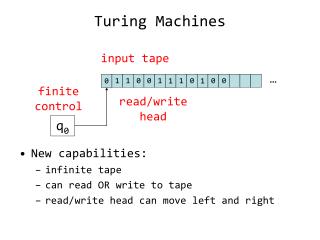
Introducing… Turing machines Infinite tape a b a b ⨆ ⨆ ⨆ Bi-directional read/write head Finite control
Formally… • A Turing machine is a 7-tuple (Q, Σ, Γ, δ, q0, qaccept, qreject), where • Q is a finite set called the states • Σis a finite set not containing the blank symbol ⨆ called the input alphabet • Γ is a finite set called the tape alphabet with ⨆∈Γand Σ⊆Γ • δ:Q ×Γ→ Q ×Γ ×{L,R} • q0∈Q is the start state • qaccept∈Q is the accept state • qaccept∈Qis the reject state
Recognizing {anbncn| n ≥ 0} Infinite tape a a b b c c ⨆ ⨆ ⨆ Finite control
Configurations • A configurationis • Current state • Current tape contents • Current head location • uqvmeans • Current state is q • Current tape contents isuv • Current head points at first symbol of v • Example • âaq1bbcc • In state q1 • Tape contents are âabbcc • Tape head is on first b
Yields • A configuration C1 yields configuration C2 if the Turing machine can legally go from C1 to C2 in a single step • yields • Written ⊢
Turing-recognizable languages • A Turing machine accepts input w if a sequence of configurations C1,C2,...,Ck exists where • C1 is the start configuration of M on input w • Each Ci yields Ci+1 • Ck is an accepting configuration • Defn 3.5: A language is Turing-recognizable if it is accepted by some Turing machine.