Download
1 / 7
70 likes | 200 Views
This section covers the techniques for adding and subtracting radical expressions using the distributive property when the expressions share the same radicand. Key examples demonstrate that if the radicands are identical, you can simply add or subtract the coefficients. It also highlights the importance of simplifying radicals into their simplest form by removing any perfect square factors, and addresses the necessity of eliminating radicals from the denominator in mathematical expressions.

E N D
Section 11.2B NotesAdding and Subtracting Radical Expressions
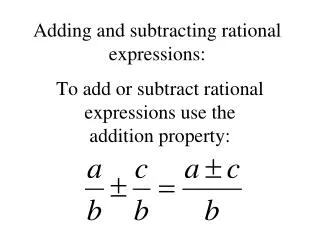
You can use the distributive property to simplify sums and differences of radical expressions when the expressions have the same radicand. Ex. ______________ The same holds true for adding and subtracting radical. If the ____________ is the same, just add or subtract the ____________. Ex. _______ radicand coefficients
If each radical in a radical expression is not in ________________, simplify them first by taking out any _____________________. simplest form perfect square factors
Fix this in your packet