Download
1 / 4
40 likes | 145 Views
This study examines the robust correlation between various impact parameters and dependent observables in nuclear collisions. We explore the feasibility of excluding peripheral collisions through selections based on particle multiplicity or transverse energy (Et) at lower incident energies. Utilizing a two-step hybrid model (QMD+SMM), we find nearly perfect agreement in charge distributions and fragment multiplicity ratios. However, challenges arise in central Au+Au collisions and multi-fragmentation scenarios due to energy and mass constraints, raising questions about the thermalization of the source.

E N D
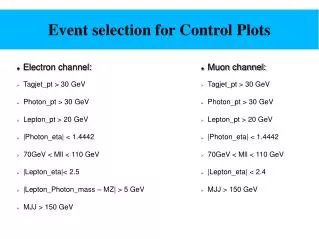
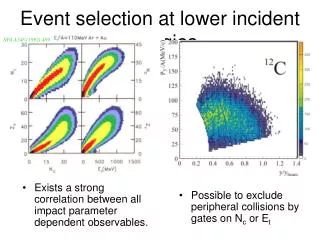
Exists a strong correlation between all impact parameter dependent observables. Possible to exclude peripheral collisions by gates on Nc or Et Event selection at lower incident energies NPA A548 (1992) 489
QMD+SMM:Two-step hybrid model comparisons E*/Athe: Charge distribution Asource : Fragment multiplicity Ecoll/A : <Et> = <Esin2q> Essentially perfect agreement is possible Williams et al.,(1997) PRC 55 (1997) R2132
Source Parameters • Only a fraction of the available energy and mass can be considered thermalized. • Same problems are observed for central Au+Au collisions: E*/A > Ecoll/A + E*thermal/A. • Similar problems are observed in projectile multi-fragmentation and light induced multi-fragmentation. PRC 55 (1997) R2132
Charge conservation constraints are too strong if reduced source is assumed. Two-steps are not really uncoupled. How isolated are these “equilibrated sources” Empirically: PRC 55 (1997) R557