
Classification/Taxonomy
Taxonomy is the discipline of classifying living organisms and giving them universally accepted names. This classification system allows biologists to study the biodiversity of life in an organized way. Common names can be misleading, varying across languages and regions. The binomial nomenclature system, established by Carolus Linnaeus, assigns each species a two-part scientific name. This chapter covers taxonomic categories, the three-domain system of life, and the importance of accurate scientific naming in understanding species relationships and characteristics.

Classification/Taxonomy
E N D
Presentation Transcript
Classification/Taxonomy Chapter 17
Why Classify? To study the diversity of life, biologists use a classification system to name organisms & group them in a logical manner.
Taxonomy Defined: Discipline of classifying organisms and assigning each organism a universally accepted name. In other words, naming things.
Why common names don’t work Common names vary among languages. Example: United Kingdom – Buzzard refers to a hawk United States – Buzzard refers to a vulture Red-tailed Hawk Honey Buzzard Turkey Vulture
Another Example: Dolphin Dolphin Tursipos truncatus Mahi mahi
Carolus Linnaeus • (1707 – 1778) • Created the system of naming we use today. • In taxonomy, a group or level of organization is called a taxonomic category or taxon.
Binomial Nomenclature • “Bi” means 2 • “nomial” means naming • Nomenclature means “the system of” Defined: In binomial nomenclature, each species is assigned a two-part scientific name. (Genus & species)
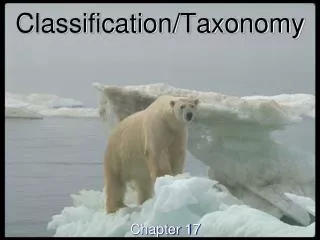
Example of Binomial Nomenclature • Polar Bear is Ursus maritimus • Ursus: genus Ursus contains 5 other kinds of bears • maritimus: species The Latin word, maritimus, refers to the sea. Polar bears often live on pack ice that floats in the sea.
Definitions to know • Genus: is a group of closely related species • Species: Group of similar organisms that can breed and produce fertile offspring
Family: Group of genera that share many characteristics • Order: Group of similar families • Class: Group of similar orders • Phylum: Group of closely related classes • Kingdom: Largest taxonomic group, consisting of closely related phyla.
Here We Go…Polar Bear Species: maritimus Genus: Ursus Family: Ursidae Order: Carnivora Class: Mammalia Phylum: Chordata Kingdom: Animilia What do these mean?...lets see
What they mean Species: maritimus (lives in marine environment) Genus: Ursus (kind of bear) Family: Ursidae (larger category of bears) Order: Carnivora (meat-eating animals) Class: Mammalia (warm-blooded, hair, & milk) Phylum: Chordata (vertebrates) Kingdom: Animilia (there are 6 kingdoms)
How to remember: Da King Phillip Came Over For Green Salad Domain Kingdom Phylum Class Order Family Genus Species
Phylum Chordata Class Mammalia Order Carnivora Family Ursidae Genus Ursus Species maritimus
The Three-Domain System • There are 3 Domains: • Domain Bacteria • Domain Archaea • Domain Eukarya • There are 6 Kingdoms: 1. Eubacteria 2. Archaebacteria 3. Protista 4. Fungi 5. Plantae 6. Animalia
The Three-Domain System • There are 3 Domains: • Domain Bacteria • Kingdom Eubacteria • Unicellular/Prokaryotes • Cell walls have Peptidoglycan • Domain Archaea • Kingdom Archaebacteria • Unicellular/Prokaryotes • Cell walls withOUT Peptidoglycan • Domain Eukarya • Kingdoms Protista, Fungi, Plantae, Animalia
Kingdom Archaebacteria • Unicellular Prokaryote • Cell walls withOUT Peptidoglycan • Extremophiles – Love extreme environments like volcanoes, hydrothermal vents, and hot springs Archaea Hydrothermal Vent Hot Spring Volcaone
Kingdom Eubacteria • Unicellular Prokaryote • Cell walls with Peptidoglycan • All other bacteria you encounter everyday E. coli Staphlycoccus Streptococcus
Kingdom Protista Video Clip: Amoeba • Unicellular or Multicellular • Live in colonies Amoeba Euglena Paramecium
Kingdom Fungi • Unicellular or Multicellular • Cell walls made of Chitin • Heterotrophs….they eat! Yeast Mushrooms
Kingdom Plantae • Multicellular • Cell walls made of Cellulose • Autotrophs….make their own food Trees & Grass Moss Venus Fly Trap
Kingdom Animalia • Multicellular • NO cell walls • Heterotrophs….they eat Worms Insects Jellyfish Giraffes
6 Kingdoms Prokaryote Prokaryote Eukaryote Eukaryote Eukaryote Eukaryote Eubacteria Archaebacteria Protista Fungi Plantae Animalia Autotroph or heterotroph Autotroph or heterotroph Autotroph/ heterotroph Heterotroph Autotroph Heterotroph Most common bacteria Cell wall w/ Peptidoglycan Includes Algae Don’t belong in other euk No cell wall No chloroplasts Multicellular “Ancient Bacteria” Cell walls w/cellulose & Chloroplasts Release enzymes to digest food Live in very hot places E. ecoli Pyrococcus furiosus Paramecium H. coccinea Fern frod Homo sapiens
Write Scientific Names Correctly • Genus species • Genus capitalized • Species lower case • Underline if hand written • Italics if typed Homo sapiens Genus species Canis lupis Hippocampus erectus
Scientific Name: Genus species If these three species belong to the same genus, they are descended from a common ancestor. Felis domestica domestica Domestic Cat Felis Felis leo leo Lion Felis margarita margarita Sand cat`
A Problem with Traditional Classification Example: The Crab, The barnacle, & The limpet • The barnacle and the limpet have similarly shaped shells & look alike • The crab has a very different body form • Based on anatomy, the barnacle & limpet could be classified together and the crab in a different group.
Related This incorrect because crabs and barnacles are actually related
Draw this! Crustaceans Gastropods Molted Exoskeleton Even though they do not look a like, crabs & barnacles are actually related Segmentation Free swimming Larva
Classification Using Cladograms Cladogram: A diagram that shows the evolutionary relationships among a group of organisms.
Crustaceans Gastropods Molted Exoskeleton Using Cladograms, you can see that crabs and barnacles share similar characteristics because they both molt & are segmented Segmentation Free swimming Larva
Crustaceans Gastropods Molted Exoskeleton You can also see that ALL have a free swimming larva stage Segmentation Free swimming Larva
Where do viruses go? Viruses: Are particles of nucleic acid, protein, and in some cases lipids that can reproduce ONLY by infecting living cells. Viruses are made of a core of either DNA or RNA surrounded by a protein coat. These are T4 Bacteriophage A bacteriophage is a virus which infects bacteria
Where do viruses go? (continued) Viruses are not considered alive because they don’t have ALL the characteristics of life. Example: They can’t reproduce independently These are the Influenza Viruses Influenza or "flu" is an infection of the respiratory tract that can affect millions of people every year.
