Download
1 / 22
220 likes | 327 Views
Learn how accounting tools help companies analyze costs and relationships for better decision-making. Discover key terms & concepts in cost-volume-profit analysis.

E N D
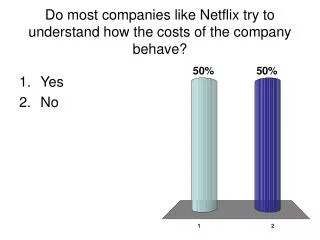
Do most companies like Netflix try to understand how the costs of the company behave? • Yes • No
Are there accounting tools to help companies such as Netflix to understand the behavior of costs and the relationship between cost, volume and profit? • Yes • No
Is the analysis of the behavior of costs and the relationship between cost, volume and profit a function of financial accounting? • Yes • No
Does the analysis of the behavior of costs and the relationship between cost, volume and profit follow the rules of generally accepted accounting principles? • Yes • No
Should all companies use the analysis of costs to help make decisions for sales mix, product costing and product pricing? • Yes • No
The activities that relate to the cost incurred are called activity bases or activity drivers. • True • False
A fixed cost is a cost that remains the same in total dollar amount as the level of activity changes. • True • False
A variable cost varies in total and per unit as the level of activity changes. • True • False
The breakeven point in sales (units) moves in the opposite direction as changes in the variable cost per unit and fixed costs. • True • False
Cost-volume-profit analysis can be presented graphically as well as in equation form. • True • False
Operating leverage is computed by dividing net sales by income from operations. • True • False
A company with high operating leverage has a high percentage of fixed costs to total costs. • True • False
The relevant range of activity refers to the • geographical areas where the company plans to sell its products • activity range where all costs are fixed • activity range over which the change in costs are of interest • activity range over which all costs are variable
A variable cost is a cost that • varies inversely on a per unit basis • management may or may not decide to incur • remains constant when changes occur in the level of activity • varies in proportion to the changes in the level of activity
Which of the following is not a cost classification in cost behavior and cost-volume-profit analysis? • Combined cost • Variable cost • Fixed cost • Mixed cost
A cost estimation technique that can be used to separate a mixed cost into its variable and fixed cost components is the • straight-line method • high-low method • effective interest method • lower of cost or market method
The systematic examination of relationships among selling prices, sales and production volume, costs, expenses and profits is called • job order costing • process costing • manufacturing costing • cost-volume-profit analysis
Contribution margin is the • excess of sales revenues over variable costs • excess of sales revenues over fixed costs • excess of sales revenues over variable and fixed costs • excess of sales revenues over the cost of goods sold
The breakeven point is the level of operations at which • a business’s revenues are greater than its expired costs • a business’s revenues equal its expired costs • a business’s revenues are less than its expired costs • a business’s revenues equal its contribution margin
Breakeven sales in units can be computed by • dividing total costs by the unit contribution margin • dividing total costs by the unit variable cost • dividing fixed costs by the unit contribution margin • dividing fixed costs by the unit variable cost
Which of the following is not an assumption in cost-volume-profit analysis? • Costs can be accurately divided into fixed and variable components • Total sales and total costs can be represented by straight lines • There is no change in inventory quantities during the period • Sales mix is not constant
The difference between current sales revenue and the sales revenue at the breakeven point is referred to as the • margin of safety • contribution margin • gross profit • target net income

![IV. Various Costs of Trade and Trade Arrangements Direct and indirect costs of trade [Head, 59-90; R/H, 159-168]](https://cdn0.slideserve.com/22356/slide1-dt.jpg)