Download
1 / 8
80 likes | 213 Views
This article discusses the essential aspects of a thermochemical model of Earth's mantle, focusing on its heat production, geochemical signatures of basalts, and consistency with seismic tomography. It highlights the long-wavelength structures characterizing the lowermost mantle, the dynamic consistency required in the model, and the complexities surrounding heat flux and geochemical reservoirs. It details methods such as finite element modeling, considering viscosity, and the influence of subducting slabs. The conclusions stress critical concepts and potential issues in applying this model to the Earth's real mantle dynamics.

E N D
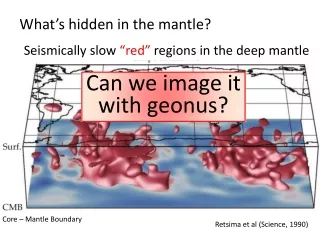
Main things a thermochemical model of Earth’s mantle should address: • Produces sufficient heat • Produces geochemical signatures of basalts • Agrees with seismic tomography • Lowermost mantle characterized by long-wavelength structure • Dynamically consistent (what does this mean?)
Approximately 50% of mantle not outgassed • 44 TW total heat flux, only 6 from crust • Evidence from heat flux for distinct geochemical resevroirs? • Calculations show an entire mantle of MORB could not produce needed 38 TW without rapid cooling (and excessive Archean T) • Why do they think the upper mantle is generally (as an entire layer) depleted?
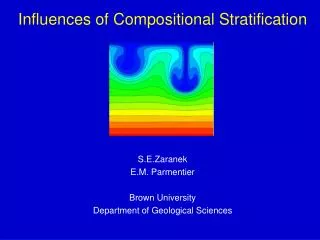
Methods • Finite Element Model with two distinct layers, one with high density • Boundary is at 1600 km • Subducting slab interaction w/ this dense layer • T and P dependent viscosity • Heating mantle from below at CMB, and from within by U, Th, and K decay
Conclusions • What is the “important concept”? • What do the authors point out as potential issues in applying their model to the real Earth?