Understanding Factors Leading to Missing Mortality Data in Emergencies
This session explores the key factors contributing to missing mortality data in emergency situations, such as lack of civic records, limited healthcare contact, and insufficient demographic data. It discusses the importance of monitoring mortality rates, highlighting Crude Mortality Rate (CMR) and Under-Five Mortality Rate (U5MR) as critical indicators of public health. The session covers data collection procedures, including two-stage cluster sampling methods, recall periods, and key variables for assessment. It emphasizes the need for effective mortality surveillance to provide early warnings of crises and improve health responses.

Understanding Factors Leading to Missing Mortality Data in Emergencies
E N D
Presentation Transcript
Mortality assessment SESSION 13
Factors leading to missing data in emergency • Lack of civic records • Low level of contacts with health institutions • Lack of basic data on demography = reliable census • Lack of effective mortality surveillance as well other surveillance that would provide proxy indicators of the crisis • Reluctance to discussions on mortality/ death
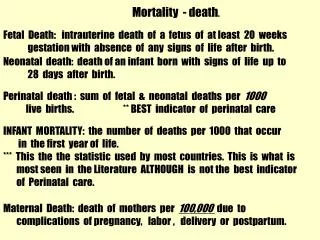
Mortality rates definitions • Crude mortality rate (CMR): an estimate of the rate at which members of a population die during a specified period • U5 mortality rate (U5MR): The total number of children who die between birth and their fifth birthday. U5MR is a useful indicator of the level of health devt in a community NB: main advantage of U5MR is early warning of a looming mortality crisis
When to assess mortality • During nutrition surveys (done concurrently • Monitor the status of the crisis after some interventions • When analyzing a severe impact of a crisis and wish to have some baseline information before commencing some interventions
Understanding mortality rates • Previous birth history: measures mortality among <5yrs & no info. on the death at Household level • Past HH census and current HH census: MR for all HH members of all age groups
Data collection procedure • Two stage cluster sampling methodology: sample selection - 30 randomly selected clusters, 30 households/cluster). 20 HH in 30 clusters is the minimum. Selection is house-house. • Exhaustive methodology (if population of interest is small) NB: Two stage cluster sampling used due to lack of detailed list of HH and HH are haphazard distributed
Key considerations • Recall period: 1 or 3 month. 3 months is ideal retrospectively • HHs irrespective of U5 child presence or not are included in the sampling frame. This reduces risk of underestimating the mortality rates. • Interview conducted to a responsible member of the HH • Tactful phrasing of questionnaires due to sensitivity of the questions on death • NB: Early warning indications do not always triggering response - hence need for advocacy
Key variables • Total no. of HH visited • No. of <5 yr children at start of the recall period • No. of <5 yr children now/today • No. of <5 deaths in the period under consideration (recall period) • Causes of death/ symptoms for each death • No. of >=5 yr adult at start of the recall period • No. of >=5 yr adult now/today • No. of >=5 deaths in the period under consideration (recall period) • Causes of death/ symptoms for each death
Mortality rate formula • U5MR= {[n/(n+N+N)/2]/p}*10,000 • Total the deaths for a given number of days (n) • Divide the total deaths (n) by the mid period population size [(n+N+N)/2] • Divide outcome with recall period in days (p) • Multiply by 10,000 for a daily under-five mortality rate • Same formula is applied in the calculation of CMR. n- total deaths, N- pop size in the start. • Alternative: [n/{(N1+N2)/2}/p]*10,000
Cut offs • In emergency, CMR and U5MR are expressed as deaths/10,000/day and they refer to aggregate deaths from all the causes/10,000 people/day • Details of the causes of death should be collected and summarized
Cut offs- U5MR and CMR • U5MR >=2 death/10,000/d-------Alert • U5MR>=4 death/10,000/d----Emergency • CMR>=1 death/10,000/d-------Alert • CMR>=2 death/10,000/d------Emergency