Download
1 / 21
210 likes | 348 Views
Chapter 11 delves into complex genetic inheritance, highlighting that some traits are controlled by multiple genes and their interactions. It explains dominance relationships, including incomplete dominance, codominance, and the role of multiple alleles. The chapter also discusses how environmental conditions and developmental stages influence gene expression, leading to variable phenotypes among individuals. Key concepts include epistasis, sex-limited traits, age-related onset of traits, and pleiotropy. These principles deepen our understanding of genetics beyond Mendelian inheritance.

E N D
Introduction • Sometimes one gene simply controls a one trait (another reason why Mendel was lucky—genotypes matched phenotypes) • However, sometimes a genetic trait can be controlled by: • a number of genes that interact with each other with some being dominant over other and… • the “conditions” the gene is under to finally produce the phenotype.
Dominance Relationships and Gene Interactions • There are various ways in which two alleles of a gene can affect the phenotype. • Often they are simply dominant or recessive • Other times, there are situations where the recessive allele may function a little or interact with the dominant allele.
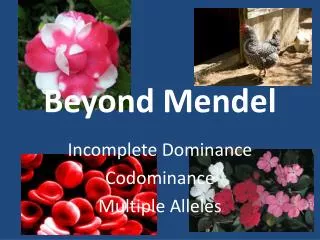
1. Incomplete dominance (partial dominance) • phenotype of a heterozygote is between the two phenotypes of the two homozygotes • Example • cR cR = red flowers • cW cW = white flowers • cR cW = pink flowers
2. Codominance • the equal expression of both alleles resulting in a mixed phenotype. • examples • Cattle – • Blood type/group –
3. Multiple alleles • Himalayan Rabbit example
4. Lethals • alleles that cause the death of the organism • recessive lethal alleles • Corn: • Huntington’s disease
5. Epistasis • one gene interferes with the expression of another gene. Fig 11.8 in text • Example B = black mouse b = brown mouse C = makes the pigment melanin necessary for either black or brown c = can’t make pigment necessary for either color
Conditional Phenotypes • How genes are expressed depends on the conditions under which they exist • The same genotype can result in different phenotypes in: • separate individuals • different tissue of the same individual
Development • As an organism grows from fertilized egg to a mature organism, certain nerves and tissues may or may not be “completed” • incomplete penetrance - • variable expressivity – • Ex.) Polydactyly: tendency to have extra fingers or toes
Sex • a sex-limited or linked trait shows up in only one sex or the other • Ex.) uteran cancer. • a sex-influenced trait can affect both sexes but the effect is different. • Ex.) middle-aged male go bald but women’s hair only thins.
Age • Some genetic traits can have variable ages of onset • Ex.) muscular dystrophy, Huntington’s disease, and baldness.
Pleiotropy • Example • Phenylketonuria (PKU) • Victims can’t metabolize a.a. phenylalanine which then builds up and leads to brain damage. • Victims also have light hair and skin color.
Polygenetic inheritance • Examples • skin color: • height: • intelligence • birth weight