Web-Based Interface for ARM Data Stream Dependency Tracking
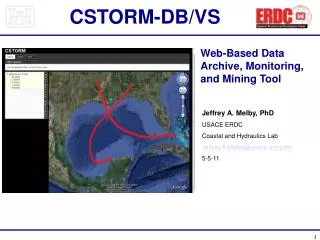
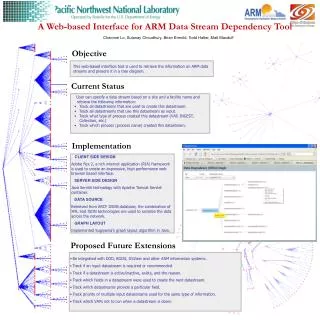
This innovative web-based interface tool retrieves information on ARM data streams and presents it visually in a tree diagram. Users can specify a data stream by site and facility name to access comprehensive details, including tracking associated data streams, identifying input dependencies, and determining the processes that create or influence the data streams. Built using Adobe Flex 2 and Java Servlet technology, the tool aims to enhance ARM data management by integrating with various information systems and providing extensive tracking and monitoring capabilities for data streams.

Web-Based Interface for ARM Data Stream Dependency Tracking
E N D
Presentation Transcript
A Web-based Interface for ARM Data Stream Dependency Tool Chaomei Lo, Sutanay Choudhury, Brian Ermold, Todd Halter, Matt Macduff Objective This web-based interface tool is used to retrieve the information on ARM data streams and present it in a tree diagram. Current Status • User can specify a data stream based on a site and a facility name and • retrieve the following information: • Track all datastreams that are used to create this datastream. • Track all datastreams that use this datastream as input. • Track what type of process created this datastream (VAP, INGEST, • Collection, etc.) • Track which process (process name) created this datastream. Implementation • CLIENT SIDE DESIGN • Adobe flex 2, a rich internet application (RIA) framework is used to create an expressive, high performance web browser based interface. • SERVER SIDE DESIGN • Java Servlet technology with Apache Tomcat Servlet container. • DATA SOURCE • Retrieved from ARCF DSDB database, the combination of XML and JSON technologies are used to serialize the data across the network. • GRAPH LAYOUT • Implemented Sugiyama’s graph layout algorithm in Java. Proposed Future Extensions • Be integrated with DOD, BODS, DSView and other ARM information systems. • Track if an input datastream is required or recommended. • Track if a datastream is active/inactive, exists, and the reason. • Track which fields in a datastream were used to create the next datastream. • Track which datastreams provide a particular field. • Track priority of multiple input datastreams used for the same type of information. • Track which VAPs not to run when a datastream is down.