Understanding Basic Probability Concepts: Applications and Calculations
This document explores fundamental probability concepts, including the addition and multiplication rules, through various practical scenarios. Examples include calculating the likelihood of randomly selected victims based on age and blood alcohol content (BAC), assessing dishwasher ownership among households with varying income levels, and determining outcomes from coin tosses. Additionally, it addresses counting rules for combinations of substitutes and customer visits. These examples aim to enhance understanding of probability and its applications in real-world contexts.

Understanding Basic Probability Concepts: Applications and Calculations
E N D
Presentation Transcript
Probability Review
Basic Concepts How many victims were in the category (B or G’)? What is the probability that a randomly selected victim would have been at least 60 years old and have had a BAC level of at least .10?
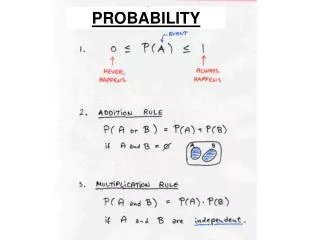
Addition Rules • For three mutually exclusive events: • P (A) = 0.3 • P (B) = 0.6 • P (C) = .01 What is the P (A or B or C)? What is the P (A or C)?
Addition Rules What is P(A or D)? What is P(B or C or G)?
Multiplication Rules A study by the US Energy Information Administration (2001) found that: • 85% of households w/ income of <$10,000 did not own a dishwasher • 20% of households w/ income of >$50,000 did not own a dishwasher If one household is randomly selected from each of the income groups, what is the probability: Neither household owns a dishwasher? Only the lower income household owns a dishwasher? Only the higher income household owns a dishwasher?
Multiplication Rules A fair coin is tossed three times. What is the probability the outcome will be: Heads – Tails – Heads?
Multiplication Rules • A machine has 16 working parts. • Each part has P(.99) of working for at least 3 years. • Parts fail independently, but if one part breaks, the machine stops working. What’s the probability the machine will work for at least 3 years?
Counting Rules • Next week, 3 teachers will be absent from classes. There are 6 substitutes available to fill these 3 positions. How many different combinations are possible?
Counting Rules • A sales representative has 35 customers in his territory and plans to visit 20 of them on his next trip. In how many different orders can he visit 20 customers?