Exploring Our Solar System: The Sun and Its Planets
110 likes | 231 Views
Discover the wonders of our solar system, starting with the Sun, which contains over 99.8% of the total mass. Its energy output is truly astronomical, and it's primarily composed of hydrogen and helium. Learn about the diverse planets, from Mercury, the closest, to the distant dwarf planet Pluto. Each planet has unique characteristics, such as Earth's abundant water, Mars' potential for liquid water, and the gas giants Jupiter and Saturn. Join us on this journey through space and understand the formation and nature of our celestial neighbors.


Exploring Our Solar System: The Sun and Its Planets
E N D
Presentation Transcript
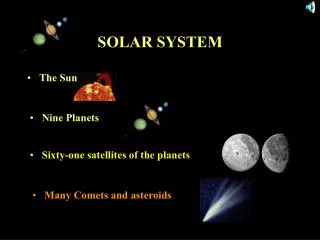
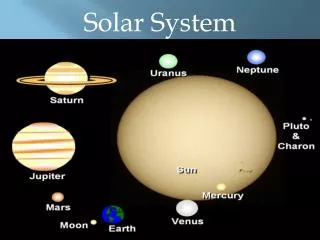
The Sun is by far the largest object in the solar system. Sun contains more than 99.8% of the total mass The Sun's energy output (3.86e33 ergs/second or 386 billion, billion megawatts) At present, the mass of the Sun is about 70% hydrogen, 28% helium Diameter: 1,390,000 KM Mass : 1.98910^30 Temperature: 5800 f (surface) 15,600,000 f (core)
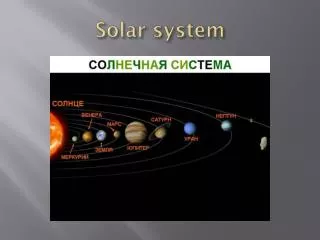
1- Mercury • Distance57,910 (000km) • Radius 2439 (km ) • Mass 3.30e23 (kg)
2- Venues • Distance: 108,200 (000 km) • Radius: 6052 (km) • Mass: 4.8710^24(kg) • (243 Earth days per Venus day)
3- Earth • Distance: 149,600 (000 km) • Radius: 6378 (km) • Mass : 5.98e24 (kg) • 71% of the Earth's surface is covered with water • The Earth formed around 4.57 billion years ago
4-Mars • Distance: 227,940 (000 km) • Radius: 3397 (km) • Mass: 6.42e23 (kg) • Named after Mars, the Roman god of war • Of all the planets in our solar system, Mars is the most likely, other than Earth, to harbour liquid water, and perhaps life.
5-Jupiter • Distance: 778,330 (000 km) • Radius: 71492 (km) • Mass: 1.90e27 (kg) • massive as all the other planets combined (the mass of Jupiter is 318 times that of Earth)
6-Saturn • Distance: 1,426,940 (000 km) • Radius: 60268 (km) • Mass: 5.69e26 (kg) • Like Jupiter, Saturn is about 75% hydrogen and 25% helium with traces of water, methane, ammonia and "rock".
7-Uranus • Distance: 2,870,990 (000 km) • Radius: 25559 (km) • Mass : 8.69e25 (kg) • It is a gas giant, the third largest by diameter, and fourth largest by mass
8-Neptune • Distance: 4,497,070 (000 km) • Radius: 24764 (km) • Mass: 1.02e26 (kg) • However, Neptune's centre is about 7,000 °C (13,000 °F), hotter than the sun's surface. This is due to extremely hot gases and rock in the center. • The planet is named after the Roman god of the sea.
9-Pluto • Distance: 5,913,520 (000 km) • Radius: 1160 (km) • Mass : 1.31e22 (kg) • It is much smaller than any of the official planets and now classified as a "dwarf planet". • In Roman mythology, Pluto (Greek: Hades) is the god of the underworld.