Mastering Addition and Subtraction of Rational Expressions: A Comprehensive Guide
This guide covers the methods to effectively add and subtract rational expressions. Learn how to identify and use the common denominator (LCD) for fractions, and how to factor expressions to simplify operations. If the denominators are the same, simply add or subtract the numerators while retaining the common denominator. For fractions with different denominators, find the least common denominator, reformat the fractions, perform the operations, and simplify the final result. Gain essential skills in rational expressions with practical examples and strategies.

Mastering Addition and Subtraction of Rational Expressions: A Comprehensive Guide
E N D
Presentation Transcript
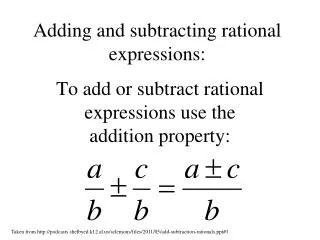
Adding and subtracting rational expressions: To add or subtract rational expressions use the addition property: Taken from http://podcasts.shelbyed.k12.al.us/sclemons/files/2011/05/add-subtraction-rationals.ppt#1
If the expressions have the same (common) denominator, add or subtract the numerators, keep the same denominator, and simplify the result. Taken from http://podcasts.shelbyed.k12.al.us/sclemons/files/2011/05/add-subtraction-rationals.ppt#1
Do the operations and simplify the result: Taken from http://podcasts.shelbyed.k12.al.us/sclemons/files/2011/05/add-subtraction-rationals.ppt#1
=1 Taken from http://podcasts.shelbyed.k12.al.us/sclemons/files/2011/05/add-subtraction-rationals.ppt#1
Taken from http://podcasts.shelbyed.k12.al.us/sclemons/files/2011/05/add-subtraction-rationals.ppt#1
=9 Taken from http://podcasts.shelbyed.k12.al.us/sclemons/files/2011/05/add-subtraction-rationals.ppt#1
Taken from http://podcasts.shelbyed.k12.al.us/sclemons/files/2011/05/add-subtraction-rationals.ppt#1
To add or subtract fractions with different denominators find the least common denominator (LCD), change each fraction so that it has that denominator then add or subtract Simply stated, the LCD is the least number (expression) that all denominators will divide into evenly. Taken from http://podcasts.shelbyed.k12.al.us/sclemons/files/2011/05/add-subtraction-rationals.ppt#1
To find the LCD • factor each denominator • write the different factors • give each factor the highest power to which it occurs • multiply the results Taken from http://podcasts.shelbyed.k12.al.us/sclemons/files/2011/05/add-subtraction-rationals.ppt#1
Factor each write each factor give each highest exponent multiply results (y+4)(y-4) and (y-4)² (y+4)(y-4) (y+4)(y-4)² (y+4)(y-4)² Find the LCD for y²-16 and y²-8y+16 Taken from http://podcasts.shelbyed.k12.al.us/sclemons/files/2011/05/add-subtraction-rationals.ppt#1
Add : • LCD = • change each fraction to LCD • add/subtract • simplify Taken from http://podcasts.shelbyed.k12.al.us/sclemons/files/2011/05/add-subtraction-rationals.ppt#1
Add : • LCD = • change each fraction to LCD • add/subtract • simplify Taken from http://podcasts.shelbyed.k12.al.us/sclemons/files/2011/05/add-subtraction-rationals.ppt#1
Add : • LCD = • change each fraction to LCD • add/subtract • simplify (Top isn’t factorable) Taken from http://podcasts.shelbyed.k12.al.us/sclemons/files/2011/05/add-subtraction-rationals.ppt#1
If the denominators have opposite factors, then change one of them using the 3 signs of a fraction rule. Taken from http://podcasts.shelbyed.k12.al.us/sclemons/files/2011/05/add-subtraction-rationals.ppt#1
Taken from http://podcasts.shelbyed.k12.al.us/sclemons/files/2011/05/add-subtraction-rationals.ppt#1
1) 2) 3) 4) Taken from http://podcasts.shelbyed.k12.al.us/sclemons/files/2011/05/add-subtraction-rationals.ppt#1
Taken from http://podcasts.shelbyed.k12.al.us/sclemons/files/2011/05/add-subtraction-rationals.ppt#1
(x+3) (x-2) (x+3)(x-5)(x-5) (x-2) Taken from http://podcasts.shelbyed.k12.al.us/sclemons/files/2011/05/add-subtraction-rationals.ppt#1
(x-1) (x-1)(x+1) (x+1)(x+1) LCM: (x-1)(x+1)(x+1) Taken from http://podcasts.shelbyed.k12.al.us/sclemons/files/2011/05/add-subtraction-rationals.ppt#1
Simplify the top and bottom: Use “tortilla method”