Understanding Cell Division and Genetic Principles in Biology
Explore the fascinating aspects of genetics and cellular processes, focusing on prokaryotic cell division, gamete production, and the principles of heredity. Learn about haploid and diploid cells, the significance of crossing over, and the role of mutations in passing traits to offspring. Delve into DNA and RNA structure, transcription and translation processes, and the importance of enzymes in nucleic acid replication. Discover key concepts such as genotype probability, sex-linked genes, and the flow of genetic information, encapsulated in the central dogma of molecular biology.

Understanding Cell Division and Genetic Principles in Biology
E N D
Presentation Transcript
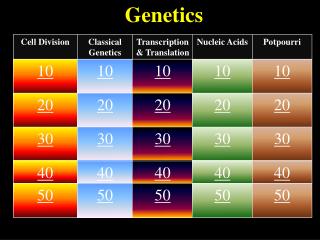
In this type of cell division, one cell divides into two daughter cells that have the same chromosome number as the first cell.
The fusion of two haploid gametes during fertilization produces this type of cell.
If brown fur (B) is dominant to white (b) what is the probability that a cross between a heterozygous brown individual and a white individual will be brown?
A B C D E F G What is the genotype of individual E?
If one strand of a DNA molecule has the sequence ATG-CCG-TAT, what will the sequence of bases on the other strand be?
If the DNA sequence ATG-GGC-TAC is transcribed, what will the sequence of bases in the mRNA be?
What part of a tRNA molecule is complementary to a part of an mRNA molecule?
What amino acid sequence will be produced by the transcription and translation of the DNA sequence TAC-AAA-TCG?
What type of nucleic acid can be found both inside and outside of the nucleus?
Mutations can only be passed on to offspring if they are present in cells that produce what?
If the diploid chromosome number of a plant is 24, how many chromosomes will be present in a pollen cell (gamete)?
In what direction does genetic information usually flow in a cell? In other words, what is the central dogma of molecular biology? DAILYDOUBLE
When homologous chromosomes exchange material during crossing over, what is the result?
What does a recombinant DNA molecule have that other DNA molecules do not?