Download
1 / 23
230 likes | 360 Views
The SYSMEX Conference 2012, presented by Andrew Terris, explored the challenges and advancements in primary care integration, focusing on quality measures and HISO standards. It highlighted the increasing demand for structured information systems to improve patient care and safety, emphasizing multi-disciplinary teamwork and shared care models. Key innovations discussed included the GP2GP system, clinical pathway evaluations, and the community ePrescription service. The presentation underscored the importance of an integrated health information ecosystem to support clinical delivery and enhance population health outcomes.

E N D
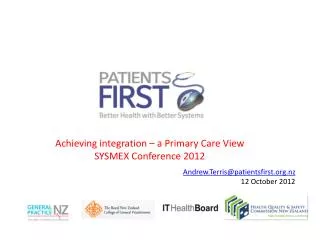
Achieving integration – a Primary Care View SYSMEX Conference 2012 Andrew.Terris@patientsfirst.org.nz 12 October 2012
Coverage • The advent of increased focus on quality measures, review and refresh of HISO standards and emergence of a more clinically rich dataset is putting increasing demands on the need for information. • What does this mean for information systems over the next year and • how can the sector use this to best advantage?
Patients First Is • The National Primary Care Quality and Information Programme • Multi-disciplinary • Focus on integration and measures Better health through better systems and better information
Where we have come from In the last 2 years, Patients First has delivered or is well down the path of delivery on: • GP2GP • Clinical Pathway tool evaluation • PMS Requirements • Health Quality Measures Library • SMM Primary Care • PMS Toolkit (universal translator) • PMS Certification/validation • eDischarge (framework) • Sector engagement and teamwork • Community ePrescription Service • Building strong relationships pan sector
Creating a Better eco-system • We have a measurements framework for a common language of measurements in health • We have a defined standard for clinical information • We can share information in a structured way • We have the start of a universal translator for systems to share data • We have a PMS certification framework to balance a clinical voice in requirements
Current Sector Context • Integration • BSMC • Primary options for acute care (incl increased community access to diagnostics) • Shared Care • New models of care • IFHCs and IFHNs • Pharmacy Services Agreement • Reducing avoidable (re)admissions • Information sharing • High focus on maternity/child health
Information sharing for? • Patient Care and Safety • Supporting clinical delivery • Population Health analysis • Predictive Risk Modelling • Shared Care • Accountability • Funding • Other?
Main trends in integration • Summary Record • Shared Care (Case Management) • Standards (RSD, ePharmacy, Status Summary Record, Interoperability Reference Architecture) • Pharmacy information for supporting LTC and care provision • PPP - aggregate information currently, some discussion re patient level data for analysis • Maternity/Child integration of care • HQSC driving more quality reporting (HQSI, Atlas of variation)
Who is doing what? (a subset view) • Northern Region – Testsafe and CDR review • Northern Region – National Shared Care Project • Midland region – call centre, central triage, patient access to record and booking • Mid Central – A/H and emergency access to information. Ambulance paramedic and call centre triage • Canterbury: eSCRV, Collaborative Care
eSCRV Privacy – Overview GP opt off Roll based filter
Integration - Vendor Responses • ORION – Concerto variations (access between secondary and primary – DHB and region driven) • Medtech – Manage My Health • Healthlink – Care Insight (real-time “pull” of data from regional eco-system for up-to-date snapshot of summary data) • HSAGlobal – CCMS (Case management for at-risk/LTC cohort)
Summary reflections • Patient identifiable data is sacrosanct • Need to share and match data to identify frequent fliers • Trend to opt off model for CDR/summary record • Who gets access to what information in a shared care context • Greater degree of community access to diagnostics and focus on referral protocols with corresponding test/orders
Summary reflections • Desire (from a quality perspective) to share information for learning and quality improvement (place higher demand on timeliness and detail of data) • Greater demand from clinical community for information flow to support effective patient care • Ministry of Health looking for increased focus on information for measuring effective primary care integration • Advent of structured information flow highlighting coding quality issues