Understanding Poiseuille’s Equation for Blood Flow in the Circulatory System
20 likes | 153 Views
This project by Jeremy Eiholzer and Nicholas Gregg explores Poiseuille's Equation, which describes the rate of blood flow through a cylindrical pipe, akin to blood vessels in the circulatory system. By deriving it from the Stokes-Navier equation, we focus on the relationship between pressure difference, viscosity, and flow rate. Our findings highlight the mathematical principles governing blood flow during the cardiac cycle. For more information, visit our website or contact us directly.


Understanding Poiseuille’s Equation for Blood Flow in the Circulatory System
E N D
Presentation Transcript
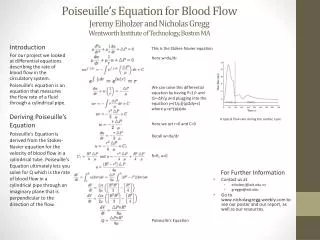
Poiseuille’s Equation for Blood FlowJeremy Eiholzer and Nicholas GreggWentworth Institute of Technology, Boston MA This is the Stokes-Navier equation Here w=du/dr Introduction For our project we looked at differential equations describing the rate of blood flow in the circulatory system. Poiseuille’sequation is an equation that measures the flow rate of a fluid through a cylindrical pipe. We can solve this differential equation by having P=1/r and Q=-ΔP/μ and plugging into the equation y=(1/μ)∫(μQdy+c) where μ=e^∫p(x)dx Deriving Poiseuille’s Equation Poiseuille’s Equation is derived from the Stokes-Navier equation for the velocity of blood flow in a cylindrical tube. Poiseuille's Equation ultimately lets you solve for Q which is the rate of blood flow in a cylindrical pipe through an imaginary plane that is perpendicular to the direction of the flow. A typical flow rate during the cardiac cycle Here we set r=0 and C=0 Recall w=du/dr R=R, u=0 For Further Information • Contact us at • eiholzerj@wit.edu or • greggn@wit.edu • Go to www.nicholasgregg.weebly.com to see our poster and our report, as well as our resources. Poiseuille’s Equation