Download
1 / 10
100 likes | 194 Views
Explore how cities redefine citizenship through informality, insurgency, and inhabitance. Examines acts of citizenship, urban refugees, and the right to the city concept. Case study of San Francisco as a sanctuary city challenging federal immigration policies. Discusses the interstitial city, politics of critique, and the evolving power dynamics of cities in shaping citizenship. Contact jonathan.darling@Manchester.ac.uk for more information.

E N D
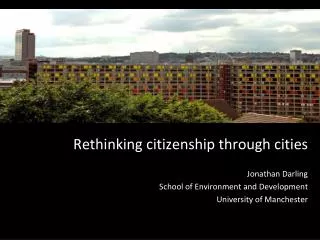
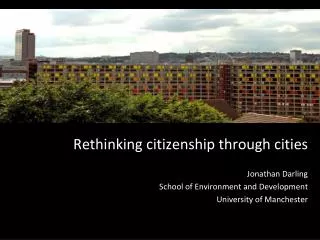
Rethinking citizenship through cities Jonathan Darling School of Environment and Development University of Manchester
‘…a right to a political space, a right to deliberate with others and participate in determining the fate of the polity to which one belongs’ (Isin 1999:267)
Informality Insurgency Inhabitance
Informality The anonymity of the city Piecemeal survival strategies Non-cooperation ordinances and urban refugees
Insurgency ‘Acts of citizenship’ (Isin 2008) Visible and disruptive displays of dissent Directed at urban authorities and at urban citizens
Inhabitance The ‘right to the city’ (Lefebvre 1996) ‘Grounded’ citizenship (Varsanyi 2006) A focus on presence and collaboration as making cities
San Francisco Sanctuary City 1989 ‘City of Refuge’ ordinance ‘Immigration-status blind’ provision of services Refusing cooperation with federal immigration policing Since 2009 the SF City ID card available to all residents
The interstitial city The city and the state The politics of critique
‘Cities have always had a social and a political identity separate from, though linked to, that of national identity and national government. Increasingly, cities have their own ‘governments’ which build their own relationships, have their own networks and have a political presence both nationally and internationally. Cities have power. This provides opportunities for organisations that want to ensure that those who are displaced can live in security’ (Tibaijuka, 2010, p.4)
Thanks jonathan.darling@Manchester.ac.uk www.producingurbanasylum.com