Download
1 / 10
100 likes | 222 Views
This lesson explores the concept of logarithms as the inverse of exponential functions. We start with a review of the exponential function in the general form and learn how to derive the corresponding y-value given an exponent. We then introduce the logarithmic function, focusing on the base 10 and natural logarithm (e). Key properties of logarithms are discussed, including misconceptions in their usage. Students will apply these properties to solve exponential equations and clarify common errors. Exercises are provided to reinforce learning.

E N D
Logarithms and Their Properties Lesson 4.1
Recall the Exponential Function • General form • Given the exponentwhat is the resulting y-value? • Now we look at the inverse of this function • Now we will ask, given the result, what exponent is needed to achieve it?
A New Function • Consider the exponential function y = 10x • Based on that function, declare a new function x = log10y • You should be able to see that these are inverse functions • In general • The log of a numberis an exponent
Note: if no base specified, default is base of 10 The Log Function • Try Theselog39 = ? log232 = ? log 0.01 = ?
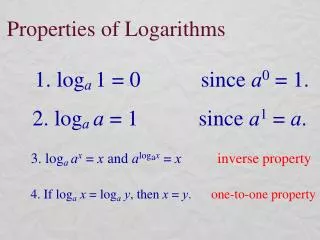
Properties of Logarithms • Note box on page 154 of text • Most used properties
Natural Logarithms • We have used base of 10 for logs • Another commonly used base for logs is e • e is an irrational number (as is ) • e has other interesting properties • Later to be discovered in calculus • Use ln button on your calculator
Properties of the Natural Logarithm • Recall that y = ln x x = ey • Note that • ln 1 = 0 and ln e = 1 • ln (ex) = x (for all x) • e ln x = x (for x > 0) • As with other based logarithms
Note this is not the same aslog 1.04 – log 3 Use Properties for Solving Exponential Equations • Given • Take log ofboth sides • Use exponent property • Solve for whatwas the exponent
Misconceptions • log (a+b) NOT the same as log a + log b • log (a-b) NOT the same as log a – log b • log (a * b) NOT same as (log a)(log b) • log (a/b) NOT same as (log a)/(log b) • log (1/a) NOT same as 1/(log a)
Assignment • Lesson 4.1 • Page 157 • Exercises 1 – 51 odd