Enhancing Eligibility Screening for Early Intensive Behavioral Intervention in South Carolina
This study highlights the importance of Early Intensive Behavioral Intervention (EIBI) for young children at risk for Autism Spectrum Disorder (ASD). It addresses the delays in identifying eligible children for Part C services, which often leads to aged-out cases before definitive diagnosis. Modeled after the STAT-MD program, it aims to improve provider training in standardized screening to enhance reliability and eligibility identification. Initial results indicate this approach successfully increased EIBI access for younger children, showcasing its potential for broader implementation.

Enhancing Eligibility Screening for Early Intensive Behavioral Intervention in South Carolina
E N D
Presentation Transcript
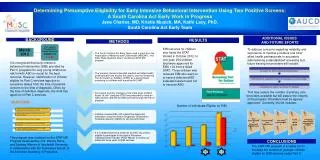
Determining Presumptive Eligibility for Early Intensive Behavioral Intervention Using Two Positive Screens: A South Carolina Act Early Work in Progress Jane Charles, MD, Kristie Musick, MA, Kathi Lacy, PhD. South Carolina Act Early Team ADDITIONAL ISSUES AND FUTURE EFORTS BACKGROUND RESULTS METHODS It is recognized that early intensive behavioral intervention (EIBI) provided by Part C programs for very young children at risk for/with ASD is crucial for the best outcome. However, identification of children eligible for Part C services lags due to excessive delays from the time of parental concern to the time of diagnosis. Often, by the time of definitive diagnosis, the child has aged out of Part C services. OBJECTIVES This program was modeled on the STAT-MD Program developed by Drs. Wendy Stone and Zachary Warren of Vanderbilt University in collaboration with the Tennessee branch of the American Academy of Pediatrics. To address concerns regarding reliability and experience of medical providers and other allied health professionals in accurately administering a standardized screening tool, future training for providers will include: This may reduce the number of primary care providers available but will assure the integrity of the program. Providers must be agency approved. Currently, the list includes: EIBI services for children who failed the STAT started in October 2012. In one year, 204 children total were approved for EIBI, 104 from a failed STAT. Three children who received EIBI who went on to have a definitive ASD evaluation were found not to have an ASD. I Number of Individuals Eligible for EIBI CONCLUSIONS The STAT MD program is a viable tool to increase the number of younger children eligible for EIBI services under Part C. As of 10/13 Since 10/12