Minimum Spanning Trees
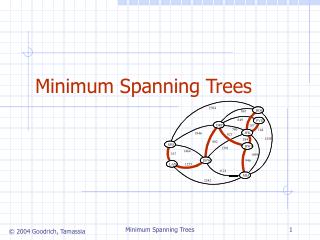
A Minimum Spanning Tree (MST) connects all nodes in a connected, undirected graph with the least total edge weight. Different algorithms, like Prim’s and Kruskal’s, can create MSTs, with unique results depending on edge weights. In real-world applications, such as a cable TV company's installation in a new neighborhood, an MST helps minimize costs by determining the most efficient paths. This guide explores MST principles, algorithms, and examples to illustrate their significance in network design and cost optimization.


Minimum Spanning Trees
E N D
Presentation Transcript
Minimum Spanning Trees By Ian Graves
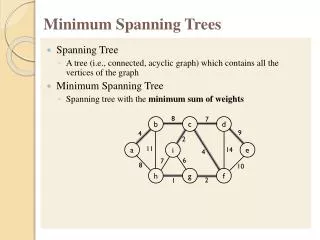
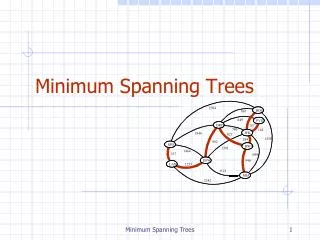
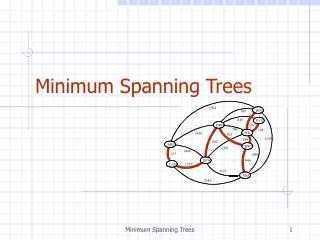
MST • A minimum spanning tree connects all nodes in a given graph • A MST must be a connected and undirected graph • A MST can have weighted edges • Multiple MSTs can exist within a given undirected graph
More about Multiple MSTs • Multiple MSTs can be generated depending on which algorithm is used • If you wish to have an MST start at a specific node • However, if there are weighted edges and all weighted edges are unique, only one MST will exist
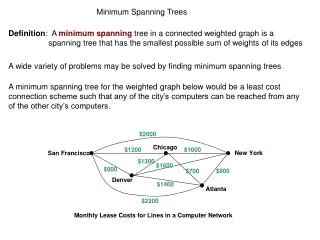
Real Life Application of a MST A cable TV company is laying cable in a new neighborhood. If it is constrained to bury the cable only along certain paths, then there would be a graph representing which points are connected by those paths. Some of those paths might be more expensive, because they are longer, or require the cable to be buried deeper; these paths would be represented by edges with larger weights. A minimum spanning tree would be the network with the lowest total cost.
Borůvka’s Algorithm • The first MST Algorithm was created by Otakar Borůvka in 1926 • The algorithm was used to create efficient connections between the electricity network in the Czech Republic • No longer used since Prim’s and Kruskal’s algorithms were discovered
Prim’s Algorithm • Initially discovered in 1930 by Vojtěch Jarník, then rediscovered in 1957 by Robert C. Prim • Similar to Dijkstra’s Algorithm regarding a connected graph • Starts off by picking any node within the graph and growing from there
Prim’s Algorithm Cont. • Label the starting node, A, with a 0 and all others with infinite • Starting from A, update all the connected nodes’ labels to A with their weighted edges if it less than the labeled value • Find the next smallest label and update the corresponding connecting nodes • Repeat until all the nodes have been visited
Kruskal’s Algorithm • Created in 1957 by Joseph Kruskal • Finds the MST by taking the smallest weight in the graph and connecting the two nodes and repeating until all nodes are connected to just one tree • This is done by creating a priority queue using the weights as keys • Each node starts off as it’s own tree • While the queue is not empty, if the edge retrieved connects two trees, connect them, if not, discard it • Once the queue is empty, you are left with the minimum spanning tree