Download
1 / 21
210 likes | 332 Views
This discussion delves into the complex Arab-Israeli conflict, examining the political and religious dynamics within Israel, the role of the U.S. as a supporter of Israel, and the historical events shaping this conflict. Students will identify key terms such as the Oslo Accords and the Two-State Solution, explore the demographic makeup of Israel and the Palestinian Territories, and understand the impacts of historical figures like Theodor Herzl, Yasser Arafat, and leaders like Anwar Sadat and Benjamin Netanyahu. This comprehensive overview provides a foundational understanding of the ongoing conflict.

E N D
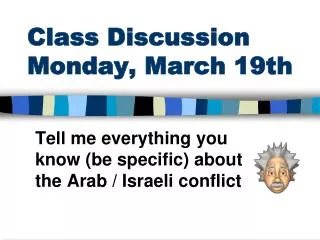
Class DiscussionMonday, March 19th Tell me everything you know (be specific) about the Arab / Israeli conflict
Here is the plan… • Students will understand the political and religious systems of Israel. • Students will be able to differentiate religious from secular Jewish citizens. • Students will comprehend the connection between Israel and the United States.
Israel • Is a 1st world country with a Democratically elected government. • The United States is a strong supporter of Israel.
Success? • The Israelis have used technology to develop industry and agriculture – the land is not rich in natural resources. • Much $ and effort is spent on national defense.
Palestine • There is NO country called Palestine. • The Palestinian Territories are the Gaza Strip & The West Bank. • Impoverished and crowded.
Terms • Oslo Accords • Balfour Declaration • Theodor Herzl • MahmoudAbbas • Yasser Arafat • UN Partition Plan • Two State Solution • Anwar Sadat • Benjamin Netanyahu • Hamas • Yitzhak Rabin • GiladShalit
Zionism • The movement to create a Jewish state was begun in the late 1800’s by Theodor Herzl. • It really gained momentum after the Holocaust.
Israel • Israel is about 75% Jewish – much of the remaining 15% are Muslims. • Within that 75% some Jews are Orthodox and others are secular.
Gaza Strip • Overwhelmingly Arab (99%) and overwhelmingly Muslim (99%) • Self rule was granted to the Palestinians on a temporary basis in 1993.
West Bank • 83% Palestinian Arab and 17% Jewish. • The Jewish “settlers” are not welcomed by their Arab neighbors and must be guarded 24/7
Intifada • Peace has been elusive because both sides have elements who would like to derail the peace process.