Download
1 / 16
160 likes | 309 Views
This guide explores the phenomenon of light refraction through different mediums, such as air, water, and glass. It explains why refraction occurs, detailing how light bends toward or away from the normal line at the interface between materials of varying densities. Key concepts include the angle of incidence and angle of refraction, along with the equation for calculating the refractive index. Through practical examples and visual aids, learners can observe how light behaves in different scenarios, enhancing their understanding of optics and its real-world applications.

E N D
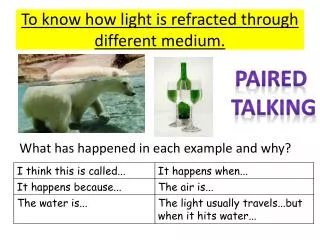
To know how light is refracted through different medium. Refraction Paired talking What has happened in each example and why?
To know how light is refracted through different medium. Success criteria- • State why refraction happens. • Describe the direction light is refracted in different situations. • Use the equation for refractive index. Team workers
To know how light is refracted through different medium. Observations- • What do you notice about the angle of refraction as the light ray enters the block (from air into glass)? • What do you notice about the angle of refraction as the light exits the glass block (from glass into air)?
Rectangular block air into block Semi circle block (block into air) Rectangular block air into block Prism (block into air)
To know how light is refracted through different medium. How does Refraction work? • As the light enters a glass block or water it is refracted (bent) when it enters and leaves the lens.
AIR GLASS normal angle of refraction angle of incidence Refraction of light at a plane surface (a) Less to more optical dense transition (e.g. air to glass) Light bends TOWARDS the normal. The angle of refraction is LESS than the angle of incidence.
angle of refraction normal angle of incidence WATER AIR (b) More to less optical dense transition (e.g. water to air) Light bends AWAY FROM the normal. The angle of refraction is GREATER than the angle of incidence.
2 different materials which have different densities. The more dense a material the more particles. Light can travel faster in air than it can in a liquid or solid so it slows down when entering them. When the refracted ray or Emergent ray leave the glass block it speeds up again and swings AWAY FROM the Normal. The Normal line is always 90° to the interface When the incident ray enters the glass block (doesn’t matter about shape!) the ray slows down and swings TOWARD the Normal line. The place where the 2 materials meet is called the interface
To know how light is refracted through different medium. • www.upscale.utoronto.ca/PVB/Harrison/Flash/Optics/Refraction/Refraction.html
normals observer AIR WATER image object at the bottom of a pool To know how light is refracted through different medium. Why a pool appears shallow
A B D E C F To know how light is refracted through different medium. Complete the paths of the RED light rays:
To know how light is refracted through different medium. A B D E C F Complete the paths of the RED light rays:
To know how light is refracted through different medium. • Refractive index = sin i / sin r • Using the table of values below, calculate the refractive index of the medium. Suggest which material the medium is made of.
To know how light is refracted through different medium. Success criteria- • State why refraction happens. • Describe the direction light is refracted in different situations. • Use the equation for refractive index. Team workers
To know how light is refracted through different medium. 1. Using the above equation calculate what the angle of incidence must have been to give the following angles of refraction in glass. • 23° • 33° • 40° 2. A beam of light shines on a diamond block with an angle of incidence of 15°. Calculate the angle of refraction.