Solving Angle Relationships and Number Problems in Geometry
In this lesson, we explore the fundamental concepts of angles, including definitions, classifications, and relationships. Students will learn about the various types of angles—acute, right, obtuse, and straight—and how to measure them. We will also introduce angle pair relationships such as complementary and supplementary angles, linear pairs, and vertical angles. Furthermore, students will solve real-world problems involving the sum of two numbers, enhancing their mathematical skills. Prepare for the upcoming quiz and test with engaging bellwork and practice questions!

Solving Angle Relationships and Number Problems in Geometry
E N D
Presentation Transcript
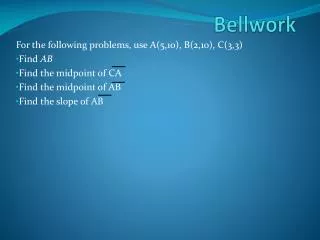
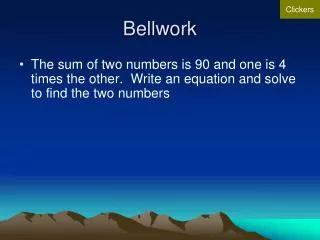
Clickers Bellwork • The sum of two numbers is 90 and one is 4 times the other. Write an equation and solve to find the two numbers
Bellwork Solution • The sum of two numbers is 90 and one is 4 times the other. Write an equation and solve to find the two numbers
Measure and Classify Angles & Describe Angle Pair Relationships Section 1.4 & 1.5
The Concept • Today we’re going to discuss the different kinds of angles • We’re also going to talk about adding and bisecting angles • We’ll also going to further that understanding by talking about special angle pair relationships
Definition • Angle • Object that is created by the connection of two rays at the same endpoints • Consists of two sides and a vertex • Named by three points (of which one is the vertex) or just by the vertex if it is not shared with another angle • Object that is created by the connection of two rays at the same endpoints • Consists of two sides and a vertex • Named by three points (of which one is the vertex) B Angle 1.4 A C Indicates angle Axis of symmetry Vertex
Congruence • Similar to our look at line segments, we have to be aware of the difference in use of the congruence and equals signs
Protractor Postulate • The measure of an angle (denoted m) is equal to the absolute value of the difference between the real numbers for the two rays as they cross a protractor • In other words, if you measure an angle with a protractor we can be reasonably certain that it’s correct…
Classification B • There are four kinds of angles • Acute • Measuring less than 90 degrees • Right • Measuring 90 degrees • Obtuse • Measuring larger than 90 degrees and less than 180 • Straight • Measuring 180 degrees A C B A C B A C A B C
On your own • What kind of angle is shown below?
On your own • What kind of angle is shown below?
On your own • What kind of angle is shown below?
Angle Addition Postulate • If P is in the interior of ∠RST, then the measure of ∠RST is equal to the sum of the measures of ∠RSP and ∠PST. R P S T
Example Find the indicated angle measure R P 35 S 23 T
On your own • What is the measure of angle ABD, if the measure of angle ABC is 102o? B 35o C A D
Application • Find if is 72 degrees R P 3x+6 S 2x-9 T
Congruency Two angles that have the same measure are considered congruent • Example 4
Bisector angles • Similar to bisectors of lines, a bisector of an angle is a ray that shares the end point of a given angle that splits the measure of the angle in half R P S T
Application • Find if is 32o and SP is a bisector R P S T
Definition • Complementary Angles • Angles that sum to 90o • Supplementary Angles • Angles that sum to 180o Angles that sum to 90o A B Complementary Angles 1.5 D C Angles that sum to 180o B Supplementary Angles 1.5 A D C Axis of symmetry Vertex
Adjacent angles • Adjacent Angles • A pair of angles that share a side R P S T • Adjacent Complementary Angles • A pair of angles that share a side that sum to 90 • Adjacent Supplementary Angles • A pair of angles that share a side that sum to 180
Example • In the figure, name a pair of complementary angles, a pair of supplementary angles and a pair of adjacent angles. • Are angle KGH and angle LKG adjacent angles? Are angles FGK and angle FGH adjacent angles? Explain. G H F 131o 41o 49o K L
On your own • What is the measure of ABD? B 35o C D A
Linear Angle Pairs • Linear Pair • Adjacent angles whose non-common sides are opposite rays • Also supplementary angles • BAD & DAC are a linear pair D A B C
Vertical Angle Pairs • Vertical Angles • Angles formed by two intersecting lines • Extended sides form opposite rays • Angle pairs are congruent • EAD & BAC are a vertical pair • EAB & DAC are a vertical pair D E A B C
Uses • We can use our understanding of linear pairs and vertical angles to solve for other angles D E A 36o B C
Application • Find D E A 141o B C
Uses • Find all the angles D E 3x-8 A 2x-2 B C
Homework • 1.4 • 3, 6, 18, 24, 26, 28, 38, 41, 42 • 1.5 • 7, 10, 14, 20-28 even, 33, 42
ACT Prep • a+b=? a b 120 • a=?
Most Important Points • Complementary Angles • Supplementary Angles • Linear Pairs • Vertical Angles • Test next Tuesday