Customer Satisfaction Profit Chain
400 likes | 1.28k Views
Customer Satisfaction Profit Chain. Prof. Markus Christen INSEAD Singapore May/June 2007. Customer Satisfaction Is Decreasing. American Customer Satisfaction Index (ASCI) Based on annual poll of more than 50.000 consumes, measuring overall satisfaction with products and services.


Customer Satisfaction Profit Chain
E N D
Presentation Transcript
Customer Satisfaction Profit Chain Prof. Markus Christen INSEAD SingaporeMay/June 2007
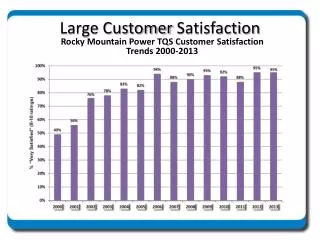
Customer Satisfaction Is Decreasing American Customer Satisfaction Index (ASCI) Based on annual poll of more than 50.000 consumes,measuring overall satisfaction with products and services. Source: http://www.theacsi.org, University of Michigan
CRM Investments Approximate Worldwide CRM Investments (applications, hardware and services)
Starbucks: Delivering Customer Service • Why successful • Tight alignment between target market (sophisticated, affluent coffee lover, coffee drinking life style) and highly differentiated value proposition • Drinking coffee as self-indulgent ritual: Best coffee • Tendency to linger, in search of a sanctuary: Physical environment • Friendly people, social interactions: Service Philosophy • Impact of growth strategy • Retail expansion: Ubiquity of stores makes Starbucks less “special” • Customer acquisition: New customers with different service needs • Routine • Pass through • Convenience • Product innovation: Increased production complexity leads to longer lines
Starbucks: Delivering Customer Service • Consequence • Conflicts between customer segments affects service quality • Longer lines, more mistakes, less time to interact and socialize • Grumpy customers, grumpy employees • Difficult to keep customer satisfaction very high with a larger and more diverse customer base • What are the appropriate metrics to manage different customers or customer segments? Customer acquisition and retention?
Product Performance Customer Satisfaction Retention / Loyalty Revenue / Profit Service Performance Employee Performance Satisfaction-Profit-Chain (SPC)
Satisfaction and Customer Behavior Correlations for 418 customers of European paper wholesaler Source: Söderlund, Vilgon & Gunnarsson 2001, European Journal of Marketing
Zone of indifference Customer Satisfaction and Loyalty Source: Jones & Sasser, HBR, Nov/Dec. 1995
Satisfaction and Performance Estimated impact of a one-unit change in customer satisfaction (ACSI) on the market value of equity (millions of dollars) Source: Ittner and Larcker, Journal of Accounting Research
-Cost, -Revenues, -Profits AssociatedCost AssociatedRevenues Product/ServiceImprovements OptimalLevel AssociatedProfits More Satisfaction Is Not Always Better
Price Premium Referrals ReducedOperating Costs IncreasedPurchases Base Profits 1 2 3 4 5 6 Years Cost of Acquisition Source: F. Reichheld & T.A. Teal (1996), The Loyalty Effect. Loyalty and Performance • Why are loyal customers more profitable? • They buy more (revenues) • They are less costly to serve (cost) • They pay higher prices • They generate more Word-of-mouth
Loyalty and Performance Butterflies True friends Strangers Barnacles Source: Reinartz and Kumar (2002), HBR, July.
Loyalty and Performance Do Profits Increase over Time?
The Relationship Continuum Transactional Orientation (Commodity) ProcurementOrientation (Deliver value added products and services) RelationalOrientation (Partnership) • Discrete transactions • Adversarial relationship • Focus on price • Multisourcing to exert power • Global sourcing • Repeat transactions • Reduction in suppliers • Integrative negotiations (not only price) • Goal of cost reduction and quality improvement through coordination • More cooperative relationships with the goal of pie expansion • Both parties focus on generating value forend-user • Buyer focuses on core competence; strategically outsources remaining activities • Highly collaborative deep, relationships with select suppliers (typically sole-source relationships) Very high competitive pressure Achieve competitive advantage
Calculating Current Customer Value Revenues (A) -direct cost = Gross margin (B) -cost-to-serve(marketing, sales, terms and conditions, support, returns, etc.) = Contribution margin (C) -fixed cost = Operating margin (EBITDA) All on a per-customer basis! Does not include intangibles (word-of-mouth, reference effects)
Tangible value metrics Current value Revenues Gross margin Cost-to-serve Contribution margin Share-of-wallet Potential value Size-of-wallet Lifetime value Non-tangible value metrics Current value Reference value Referral value Cooperation value (e.g., shared intelligence) Potential value Future value Key Metric: Customer Value
Customer Value Concentration Brazilian Grocery Store
Customer Value Concentration US Pharmaceutical Firm
Customer Value Analysis • Objective: The result of the analysis should allow to evaluate the following: • Value level • Average value over all customers • Value disparity • Difference Highest – Lowest value • Ratio of 90th percentile /10th percentile (if > 15 then high disparity) • Value concentration (heterogeneity) • 80/20 rule (80% of contribution come from x% of customers) • Gini Coefficient (> 80% = high concentration) • All analyses to be done • Across all customers • On segment level (geography, business line, etc)
Personnel 8.99 Stated Sales Loyalty 8.76 Insurance Models 8.50 0.314 0.410 0.023 Financing 0.087 Profit New Car Stated Sales Satisfaction 8.73 Information 8.48 -0.055 0.168 0.035 Volvo Card 0.115 0.094 Delivery 8.68 0.492 0.072 Workshop Loyalty Car Satisfaction 9.26 Source: Johnson and Gustafsson Jossey-Bass, 2000 Putting It All Together Sales Satisfaction Model forLoyal Volvo Customers
Summary • S-P chain is a powerful concept for guiding customer-level actions • Its all about optimal satisfaction and optimal retention levels • Need for careful application to own environment • Necessitates “correct” measures and operationalizations • Forces to explore causal linkages • Sheds light on correct metrics
Summary • Looking at value to and from customers • Provides focus: target only potentially profitable customers • Think about what drives customer value (to the firm) • Enables resource allocation that is fair from a customer perspective and makes business sense economically • CRM is the strategic process of selecting the customers a firm can most profitably serve and shaping the interactions between a company and these customers. • Ultimate goal: Improve marketing decision-making and resource allocation
Rule 10: Customer Value Not all happy customersare loyal customers andnot all loyal customersare worth keeping: Measure & managecustomer profitability