Understanding Membrane Movement: Diffusion and Osmosis in Biology
This overview explores the concepts of diffusion and osmosis, fundamental processes in cellular biology. Diffusion is the movement of particles from areas of high concentration to low concentration, occurring without energy expenditure. Osmosis, a specific type of diffusion, refers to the movement of water through a semi-permeable membrane towards higher solute concentrations. We also differentiate between passive transport (like diffusion and osmosis) and active transport, which requires energy to move substances against their concentration gradient, involving processes like endocytosis and exocytosis.

Understanding Membrane Movement: Diffusion and Osmosis in Biology
E N D
Presentation Transcript
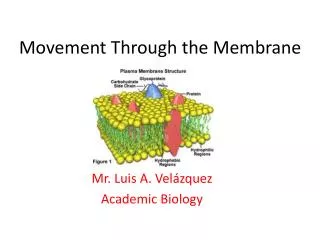
Movement Through the Membrane Mr. Luis A. Velázquez Academic Biology
Diffusion DiffusionMotion of particle for high concentration To low concentration. This causes many substances to move across a cell membrane but does not require energy.
What is Osmosis? Osmosis is a type of diffusion. The movement of water across a semi permeable membrane. Osmosis is the movement of water through a semi permeable membrane to a higher concentration of solutes .
Passive Transport • When material move from areas of high concentration to low concentration they don’t requires energy. • Examples • Diffusion • Facilitate Diffusion • Osmosis Particles Water
Active Transport • When material move from areas of low concentration to high concentration they requires energy. • Examples • Endocytosis • Exocytosis
Types of Endocytosis • Phagocytosis • Pinocytosis
Interactive Review http://www.northland.cc.mn.us/biology/BIOLOGY1111/animations/passive1.swf