Zwerger Muller SN waveforms
This study examines the Zwerger-Müller (ZM) waveforms, highlighting how initial angular momentum and rotational energy influence differential rotation. Parameters A (initial angular momentum) and B (energy ratio) dictate the number of bounce peaks observed in the waveforms. Variations in the adiabatic index Gr, ranging from 1.325 to 1.28, reveal significant impacts on peak amplitude. The research includes data from LIGO projects and demonstrates the correlation between waveform simulations and real-world data, providing confidence in the response functions used for analysis.

Zwerger Muller SN waveforms
E N D
Presentation Transcript
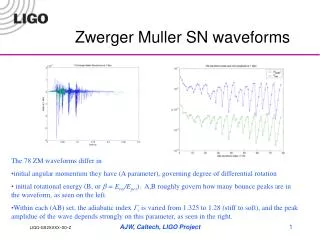
Zwerger Muller SN waveforms • The 78 ZM waveforms differ in • initial angular momentum they have (A parameter), governing degree of differential rotation • initial rotational energy (B, or b = Erot/Epot). A,B roughly govern how many bounce peaks are in the waveform, as seen on the left. • Within each (AB) set, the adiabatic index Gr is varied from 1.325 to 1.28 (stiff to soft), and the peak amplidue of the wave depends strongly on this parameter, as seen in the right. AJW, Caltech, LIGO Project
SineGaussians Sine Gaussians, f0 evenly spaced in logf Left: t = 0.05 s, Df = 6.3 Hz Middle: t = 0.005 s, Df = 63 Hz Right: t = 10/f0 , Df ~ /f0 AJW, Caltech, LIGO Project
sensitivity with PZ fit to S1H2 My reconstruction with Mike’s PZ fit, on left. Right: Calibration web page. They agree very well. AND, the burst at 100 Hz injected into LDAS and passed through the response function in datacond, agrees perfectly with the matlab simulation. Confidence in use of response function! AJW, Caltech, LIGO Project
Same for S1H1 AJW, Caltech, LIGO Project
And for L1 AJW, Caltech, LIGO Project