Understanding Learning Progressions: A Guide for Educators
This guide explores learning progressions, structured maps that depict student understanding, starting from naïve ideas and advancing to scientifically accepted explanations. It outlines the steps for creating effective learning progressions, including selecting key concepts, describing different understanding levels, developing assessment prompts, and providing meaningful feedback. By using collaborative templates and engaging in discussions, educators can enhance student comprehension of complex concepts. Strategies for continuous assessment and progression towards accurate ideas are also highlighted.

Understanding Learning Progressions: A Guide for Educators
E N D
Presentation Transcript
Learning progressions A simple-minded template from a simple-minded person
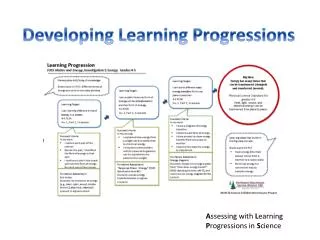
What are learning progressions? • Maps of student ideas bordered on one end by naïve ideas about the natural world (sometimes called misconceptions) and on the other end by grade-appropriate scientifically accepted explanations. • Creating learning progressions entails the following: • Deciding on the key concept • Developing a short description of that concept at different levels of understanding • Writing assessment prompts to elicit student ideas • Constructing strategies to give students feedback on their current ideas and a means to progress toward more accurate ideas.
Steps to developing a learning progression • Accounting of student ideas of a single construct. • Assessment prompts to elicit student thinking. • Age-appropriate examples of student responses. • Feedback strategies to more students to a more appropriate understanding.
Using the template: seasons • Write a description of the concept at the three levels of understanding • Discuss as a class after a few minutes • Write sample assessment prompts to elicit student ideas at each level • Discuss as a class after a few minutes • Brainstorm what you students would say that typifies their understanding at each level • Discuss as a class after a few minutes • Determine how to provide meaningful and timely feedback. This is the toughest step. • Discuss as a class after a few minutes • If you finish any step early, you may go on to the next step.
Using the template: your concept here! • Work with others in your school, district, or grade level to write your own learning progression for a concept of interest to you. • The instructors will wander around and help you out. • We have a few resources available.