### Understanding Refraction: Principles and Applications in Optics ###
Refraction is the bending of light waves as they transition between different media, altering speed and direction while frequency remains constant. This concept can be illustrated through analogies, such as soldiers marching from a road onto sand. Key principles, including Snell's Law and total internal reflection, explain how light behaves at interfaces. Applications range from prisms to fiber optics, revealing the broader implications of refraction in technologies and natural phenomena like mirages. Understanding these concepts is essential for exploring optics in science and engineering. ###

### Understanding Refraction: Principles and Applications in Optics ###
E N D
Presentation Transcript
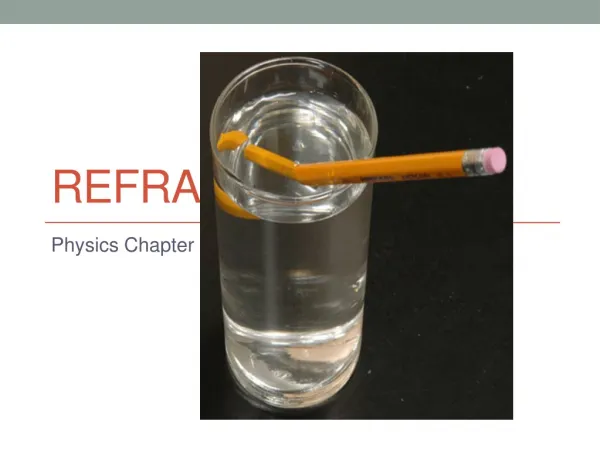
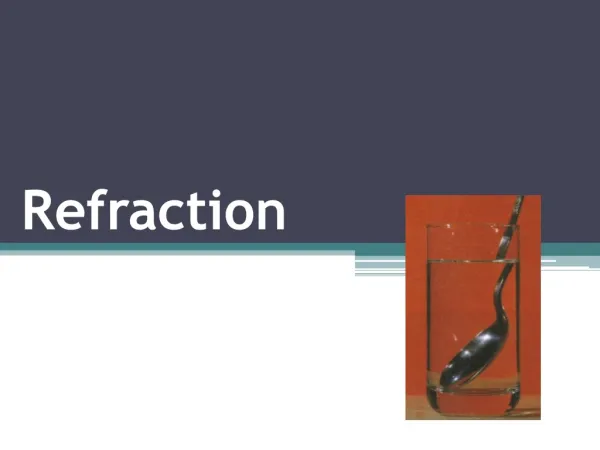
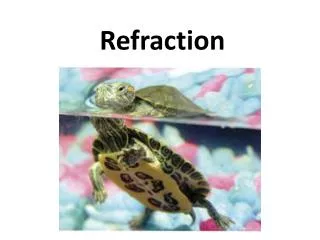
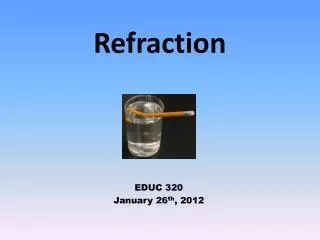
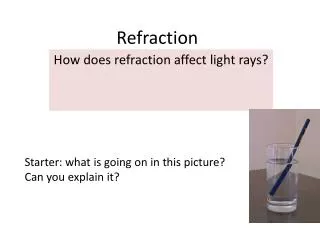
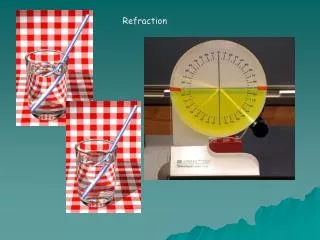
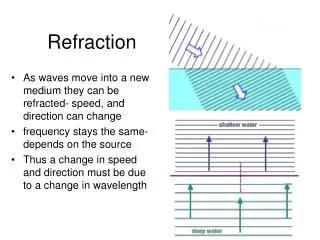
Refraction • As waves move into a new medium they can be refracted- speed, and direction can change • frequency stays the same- depends on the source • Thus a change in speed and direction must be due to a change in wavelength
Refraction – Soldier Analogy Imagine a line of soldiers marching from a road onto sand They will move more slowly on the sand and the line will bend
Direction of Bending • FST- fast to slow: towards the normal • SFA- slow to fast: away from normal • Draw the estimated refracted ray
Refraction What Are The Different Media? Water Glass Air
Dispersion of light through refraction • Different wavelengths of light refract by different amounts • Thus the prism
Mirages • Hot air near surface of road causes bending • Your brain interprets this the only way it knows how- there must be water on the road that is reflecting
Quantifying Refraction • n= index of refraction (no units) • n=c/v • c= speed of light in a vacuum • v=velocity of light in the medium • Remember v=f ? • n= f/ 2f • Since f does not change n=/2
Light at interface between 2 mediums • When light reaches interface, it generally splits into 2 parts: • Part is reflected (follows law of reflection) • Part is refracted • Refracted ray enters new medium and can change speed, wavelength, and direction
Snell’s Law • n1sin1=n2sin2 • All incident and reflected are labeled (1) and all refracted are labeled (2) • Refraction is reversible- you could turn light ray around and it would follow the same path
Snell’s Law • In lab, we’ll often use a semicircular tray • Notice how if you aim the incident ray at the center of the flat side, it will exit the tray at the normal to the curved surface • Since = 0 there will be no refraction at that interface
Problem Solving: Snell’s Law • nair=1 • nwater=1.33 • Find the angle of refraction • Check your answer using the FST, SFA rule
Snell’s Law: Multiple Interfaces • Snell’s law can be used to go through successive interfaces • Find the angle of refraction within the glass • Find the angle of refraction when it re-enters air nglass=1.52
Snell’s Law: prisms • Where does the light exit the glass and at what angle? • Treat it like the previous layer problem but now the layers are not parallel
Total Internal Reflection (TIR) • When n1>n2 the refracted ray will bend away from the normal • As you increase 1 you will reach a point where the r=90 • The refracted ray now doesn’t leave the first medium • If you set r=90 and solve for 1 you find the critical angle (c) where TIR occurs
TIR • At any angle greater than the critical angle, you will have TIR • Remember it only happens from a higher n into a lower n medium
TIR problems • Calculate the critical angle for an ethanol-air boundary. • Draw a diagram of the path of the light ray at the critical angle • nethanol = 1.36 47.3 light travels from ethanol to air
Total Internal Reflection Diamonds
Total Internal Reflection Fiber Optic Data Cables
Total Internal Reflection Rainbow
Lenses • Ray tracing for lenses similar to spherical mirrors except light passes through instead of reflecting • Lenses have real or virtual image
Converging Lenses • Converging: thicker in middle • Light refracted through real focus • forms REAL, inverted IMAGE
Image Formation: Converging Lens • RULES- use the 2 that fit the situation • Incident ray entering parallel is refracted through focus • OR Incident ray entering via the focus is refracted parallel • Ray through center of lens doesn’t bend
Diverging Lenses • Diverging: thinner in the middle • Light bends AWAY from a virtual focus on the incident side of the lens • Virtual, upright image
Image Formation: Diverging • RULES- use the 2 that fit the situation • Incident ray entering parallel refracted away from virtual focus • Incident ray entering through virtual focus refracted parallel • Incident ray passing through center of lens doesn’t bend
Mathematics of Lenses • Similar to Mirrors- uses same equations • BEWARE OF SIGNS SIGN RULES • Converging: f is + • Diverging: f is negative • Si is + for real images • Si is - for virtual images
Lens Equation Problem • An object is placed 7.10cm to the left of a diverging lens whose focal length is f=-5.08cm. • Draw ray diagram. • Find the image distance and determine is image is real or virtual. • Find the magnification.
solution • 1/si=(1/-5.08) - (1/7.10) • si=-2.96 • Since si is negative, image is virtual and located to the left of the lens • M=-si/so=-(-2.96)/(7.10)= 0.47
Problems with multiple lenses • Treat each lens separately- work through them in order • Use the image from the first lens as the object for the 2nd and continue this process until all lenses used