Understanding Movement: The Roles of the Skeletal and Muscular Systems
This chapter explores the integral roles of the skeletal and muscular systems in human movement and protection. It explains how muscles exert forces, facilitating movement by pulling on bones at joints, which function as levers. The text delves into the concepts of force, work, and simple machines, illustrating how these principles apply to bodily functions. It also highlights the importance of force direction and magnitude in effective movement. Finally, it examines how understanding these mechanics can enhance our approach to physical tasks.

Understanding Movement: The Roles of the Skeletal and Muscular Systems
E N D
Presentation Transcript
Chapter 10: Movement and Forces 10.1 The skeletal system provides movement and protection 10.2 The muscular system makes movement possible 10.3 Muscles exert forces 10.4 Bones and joints at as levers
Warm-up True or False • Hinge joints allow a person to move in almost any direction. • A hinge joint allows a person to move forward in one direction and back. • Muscles work together in coordinated groups to move bones. • True • When a skeletal muscle relaxes and lengthens, it exerts a force that pulls bones. • When a skeletal muscle contracts, it exerts a force that pulls bones.
Muscles provide forces that produce motion • Force – a push or a pull • Force changes the motion of an object • Forces exerted by your body comes from muscles • Contract muscles – pull bones movement • Pull harder? More force • Muscle fibers contract – more/larger fibers = more force • Energy needed to apply force – from chemical energy (cellular respiration and fermentation)…from food
Forces act along the muscles • Bicep curl – feel tendon (like a string) pulling the bone from the forearm to your shoulder • The direction of the force from your biceps acts along this line parallel to the direction of the contraction • Both size and direction of force are important • Forces from your muscles vary: • Start to move your arm – muscles stabilize • At 90o, most force • When muscles pull in the direction in which the joints move most easily, their effective force is greatest It’s physics! (and math!)
Muscle & using force effectively • Pull the suitcase handle at an angle • Some applied force pulls object upwards • Some applied force pulls object forwards • you are not using all of the applied force to move the object forward • Pull the suitcase handle parallel to the direction to move • most of the applied force is used to move the suitcase forward • (what about the rest of the force?)
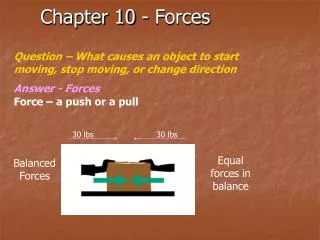
More than one force affects your body • Hold arms out • Downward force from…gravity! Called “weight” • Add a rock – even more “weight” • Forces acting on a book on the table? • Forces acting on you? • Forces can act in opposing directions • Balanced forces = no force no motion • Unbalanced forces = unequal forces motion Gravity – down Table - up Gravity – down Floor - up
Some body parts act like simple machines • How to turn a small force into a larger one? • Can’t carry a large box up the stairs • How can you move the box? • Build a ramp (a type of inclined plane) • Less force is needed because it is applied over a greater distance • Work: the amount of energy that you transfer to an object when you move it over a distance • is a transfer of energy • you do work on an object • If you exert a force on the object to move it, but it doesn’t move – no work was done • If the object moves – work is done • Holding the box, or holding a rock in your hand, is not “work”
Simple machines (6) (non-electronic) • (devices on which all other mechanical machines are based) • Help people do work (but don’t change the total amount of work required) • pulley, lever, screw, wheel and axle, wedge, and inclined plane • Household examples of simple machines? • using a pulley to raise a flag • using a hammer as a lever to pull out nails • screwing shelves into a wall • moving dirt with a wheelbarrow • using a knife acting as a wedge to slice an orange
Simple Machines • Help people do work • Do NOT change the amount of work required to move an object from location A to location B • Allow us to apply less force over a longer distance to perform the same amount of work W = F xd • tradeoff between force and distance • (ex: long ramp vs stairs)
Simple machines model how the body works • Use them to model the way that limbs work • Not a perfect model, but a useful way to describe and understand how complex systems interact • Three simple machines help model movement in the body: • Pulleys • Inclined planes • Levers
Pulleys • Help change the direction of force • Ex: fixed pulley at the top of a flag pole (or mini-blinds) • You don’t change the distance the flag moves or the force needed to move it – just the direction of the force • force pulling the flag upward = your downward force • allows you to take advantage of the downward pull of your weight to move a load upward
Pulleys in the body • Recall: muscles in the limbs are attached to two or more bones by tendons • Most of the skeletal muscles are attached to one end of a bone, stretch across a joint, and are attached to another bone • When the muscle passes over a joint, the joint can act as a fixed pulley – changes direction of force • Ex: shoulder • Muscles crisscross the shoulder joint, attaching to the bones at many points and allowing many directions of motion • Ex: wrists and hands • Long ligaments and tendons allow the fingers to be moved by muscles far away in the forearm • Wiggle the fingers of your hand – feel forearm http://youtu.be/6RbDkz737oA
Inclined planes in the body • A ramp, a simple machine that decreases the force required to move a heavy object • decreases the effective weight of a car • Gliding joints - feet and wrists • have slightly slanted or inclined surfaces where the bones meet • Nearly flat bone surfaces glide over each other, allowing only limited motion
Levers in the body • muscle pulling on a bone can be compared to a lever • A lever is a solid bar, or rod, that moves around a fixed point, a fulcrum • Ex: a crowbar • Body: each bone as a rod and each joint as a fulcrum • (more in 10.4) Bill Nye -Simple Machines
http://www.edheads.org/activities/simple-machines/frame_loader.htmhttp://www.edheads.org/activities/simple-machines/frame_loader.htm http://www.msichicago.org/fileadmin/Activities/Games/simple_machines/