
Busting the king’s gambit
In this lecture by Dan Garcia at UC Berkeley, delve into the fascinating world of higher order functions (HOFs) in programming. The session includes a unique exploration of chess strategy, specifically the King's Gambit, analyzed using the computational power of IBM Watson. Garcia shares insights on HOFs, including mapping, reporting, and reducing lists, providing practical examples and applications. Join us to enhance your computational thinking and understand how complex problems can be approached through programming paradigms.

Busting the king’s gambit
E N D
Presentation Transcript
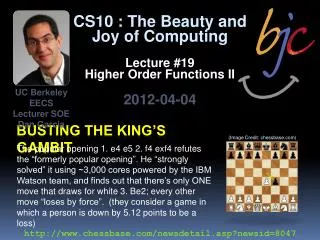
CS10 : The Beauty and Joy of ComputingLecture #19Higher Order Functions II 2012-04-04 UC Berkeley EECSLecturer SOEDan Garcia The popular opening 1. e4 e5 2. f4 exf4 refutes the “formerly popular opening”. He “strongly solved” it using ~3,000 cores powered by the IBM Watson team, and finds out that there’s only ONE move that draws for white 3. Be2; every other move “loses by force”. (they consider a game in which a person is down by 5.12 points to be a loss) (Image Credit: chessbase.com) Busting the king’s gambit http://www.chessbase.com/newsdetail.asp?newsid=8047
Today • Review useful HOFs • map Reporter over List • Report a new list, every element E of Listbecoming Reporter(E) • keep items such that Predicate from List • Report a new list, keeping only elements Eof List if Predicate(E) • combine with Reporter over List • Combine all the elements of List with Reporter(E) • This is also known as “reduce” • Acronym example • keep map combine • The script, run and launch • For each • Compose example