Download
1 / 43
440 likes | 542 Views
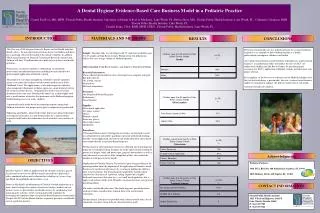
This model focuses on providing comprehensive dental care in a school-based program at Chemawa Indian Health Center, addressing oral health disparities and promoting optimal health among American Indian and Alaska Native populations. The program includes collaboration between school staff, health facility staff, dental students, and volunteers to prioritize preventive, clinical, and specialty care for students aged 14-19. Screenings, documentation, and treatment are key components to address the prevalence of dental caries and untreated decay in this population, aiming to improve oral health outcomes and reduce oral pain. The model also emphasizes the importance of access to preventive services for low-income children to meet national targets. By implementing this model, the program aims to enhance oral health, overall well-being, and learning outcomes within the community.

E N D
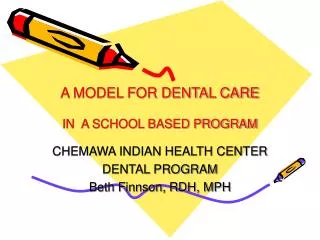
A MODEL FOR DENTAL CAREIN A SCHOOL BASED PROGRAM CHEMAWA INDIAN HEALTH CENTER DENTAL PROGRAM Beth Finnson, RDH, MPH
Oral Health in America • A Report of the Surgeon General • David Satcher, MD, 2003 • Silent epidemic affecting… • Poor children • Elderly • Racial and ethnic minority groups
World Health Organization “Dental…disease is not eradicated, but only controlled…”
Dental Caries • Chronic childhood disease • 51 million school hours lost yearly • 164 million work hours lost yearly • 16,000 school hours lost yearly in Oregon
Oral Health and General Health • Optimal oral health provides… • Speaking • Smiling • Chewing • Tasting • Swallowing
Oral Health and Learning • Early tooth loss results in… • Failure to thrive • Impaired speech development • Malocclusion • Reduced self esteem
Oral Health and Learning • Chronic Dental Pain causes… • Anxiety • Fatigue • Irritability • Depression • Inability to concentrate • Poor nutrition
OUR MISSION… • To raise the physical, mental, social, and spiritual health of American Indians and Alaska Natives to the highest level.
OUR GOAL… • To assure that comprehensive, culturally acceptable personal and public health services are available and accessible to American Indian and Alaska Native People.
OUR FOUNDATION… • To uphold the Federal Government’s obligation to promote health American Indian and Alaska Native people, communities, and cultures and to honor and protect the inherent sovereign rights of Tribes.
IHS/Tribal Healthcare Systems • 48 hospitals • 280 health centers • 147 health stations • 34 urban health projects • 9 residential treatment centers • 176 Alaska village clinics
Indian Health Disparities • 55% AI/AN rely only on IHS healthcare • Reduced life expectancy • Higher infant mortality rate • Safe/adequate water supplies • Waste disposal facilities
Indian Population • 1997-1999 Current Population Survey • Larger families • Less health insurance • Lower household median income • Lower educational levels • Higher unemployment rates • Young population
Service Population Trends • 65% population increase (1990-2006) • Increase in life expectancy (64-73) • Federal recognition for more tribes • 56% urban • 44% reservation or rural areas • Inadequate IHS budget
Indian Health Service • Mobile Dental Van
Challenges in IHS Dental Programs • 2,800 patients per IHS dentist • 1,500 patients per U.S. dentist • $50 average IHS expenditure per patient • $300 average U.S. per patient • 25% dental access for Indian people
Oral Disease Trends • 76% pre-school children with caries • 68% adolescent children with caries • Increased access for sealants • 63% 8 year-olds with at least 1 sealant
Chemawa Indian School Forest Grove
Chemawa Indian School Indian Boys
Chemawa Indian School Salem, OR
Chemawa Indian School Totem Pole
Chemawa Health Center • Comprehensive health care facility Medical Pharmacy Dental Public Health Optometry Behavioral Health Lab School Nursing Radiology Podiatry Registration/Billing/Coding
Chemawa’s Model for A Dental SBHC Program • Collaboration • School staff • Health facility staff • Dental students • Dental hygiene students • Volunteers
Model for Dental SBHC • Screen process • Document, document, document… • Prioritize • Preventive care • Clinical care • Specialty care • Evaluation
Documentation • Name Hygiene care • Chart Sealants • Home state Retention Rates • Screen date Extractions • Exam date Root canals • Number of caries PTC • Urgent needs Drop
Screen Results 2007-2008 • 462 students, aged 14-19 • 349 screened • 99% have had dental caries • 82% with untreated decay • 15% reported oral pain
Treatment Results 2007-2008 • 51% complete exams • 9% extractions • 99% oral hygiene education & cleaning • 85% received 498 dental sealants • 47% completed treatment
387 students, aged 14-19 387 screened 97% have had dental caries 73% with untreated decay (1395 carious teeth) 14% reported oral pain Screen Results 2008-2009
Receipt of Preventive Services by Low Income Children 1996 2000 2010 Target = 57% Note: Data are for children under 19 years. Low income is less than 200% of poverty level. Preventive services include examinations, cleaning, x-rays, fluoride treatments and sealant applications. Source: Medical Expenditure Panel Survey, AHRQ. Obj. 21-12
Unreliable estimate, relative standard error >30%. Dental Sealants: 1988-94 and 1999-2000 1988-94 1988-94 1999-2000 1999-2000 Percent 2010 Targets Total White Black Mexican American Total White Black Mexican American 6-11 Years 12-18 Years Note: Targets are for children 8 years and 14 years. Black and white exclude persons of Hispanic origin. Persons of Mexican-American origin may be any race. Source: National Health and Nutrition Examination Survey, NCHS, CDC. Obj. 21-8
Adolescents 12-18 Years Who Ever Had Caries in Permanent Teeth, 1988-94 and 1999-2000 Percent 1999-2000 2010 Target 1988-94 Female Male Total White Black Mexican American Note: Target is for adolescents 15 years old. Black and white exclude persons of Hispanic origin. Persons of Mexican-American origin may be any race. Source: National Health and Nutrition Examination Survey, NCHS, CDC. Obj. 21-1c
Oregon Smile Survey 2007 • 3,865 1st,2nd & 3rd graders • Oregon ranks 25/32 states • Disease disparities • Geographic • Poverty • Dental insurance • Race/ethnicity
Oregon Smile Survey 2007 • 64% of children have had dental caries • 20% of children with rampant decay (7+) • 35% of children with untreated decay • 25% with no dental insurance • 9% with no dental home • 20% need urgent care due to pain/infection • 43% with dental sealants
Oregon Smile Survey • Recommendations • Community water fluoridation • Early-childhood cavities prevention • School based fluoride supplement program • School based dental sealant programs
Oregon Dental Association Oregon Dental Hygienists’ Association Dental Foundation of Oregon Tooth Taxi Medical Teams International Mobile Dental Van Boys and Girls Club Resources
Resources • Oregon Smile Survey • Burden of Disease in Oregon • Oral Health Data Book • King Fluoride • Dental Sealants Protect Oregon Teeth: A Guide… • http://www.oregon.gov/DHS/ph/oralhealth
Questions ? • Beth Finnson, RDH, MPH • Chemawa Indian Health Center • 3750 Chemawa RD NE • Salem, OR 97305 • 503-304-7631 • beth.finnson@ihs.gov