Understanding Benzylic Radicals and Chain Oxidation in Alkylbenzenes
This lab guide delves into the chemistry of side chain oxidation in alkylbenzenes, focusing on the aliphatic portion. It explains key concepts such as benzylic radicals, benzylic hydrogen atoms, and benzylic cations. Learn about free radicals, their high reactivity, and their role in chain reactions like halogenation—particularly bromination and chlorination. The oxidation process is highlighted, detailing how it begins at the benzylic carbon and the degradation of longer alkyl groups to benzoic acids. Enhance your understanding of aromatic chemistry and radical reactions.

Understanding Benzylic Radicals and Chain Oxidation in Alkylbenzenes
E N D
Presentation Transcript
Side chain oxidation Lab 2
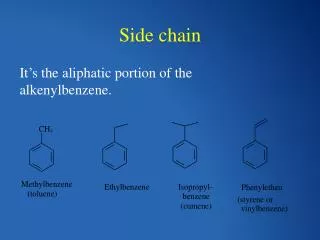
Side chain It’s the aliphatic portion of the alkylbenzene.
Benzylic Radicals and Cations • Terms you should know : • Free Radicals • Benzylicradical • Benzylic hydrogen atom • Benzyliccation
Free Radicals • An atom or group of atoms that has at least one unpaired electron ,so: • Unstable • Highly reactive
Benzylic radical • Is the general name applies to all radicals that have unpaired electron on the carbon atom attached directly to the benzene ring.
Benzylic hydrogen atoms • Is the hydrogen atom of the carbon atom that directly attached to the benzene ring.
Benzyliccation: • Is the departure of a leaving group (LG) from a benzylic position.
Bromination Chlorination
Benzylichalogenation Chain Initiation Step 1 Chain propagation Step 2
Benzylichalogenation Step 3 Chain Termination Step 4
Oxidation of the side chain • The oxidation can be carried out by the action of hot alkaline potassium permanganate.
Oxidation of the side chain • Oxidation of the side- chain take place initially at the benzylic carbon; any alkylbenzenes with alkyl group longer than methyl are ultimately degraded to benzoic acids:
Oxidation of the side chain • Reaction: