10 LCM using Primes
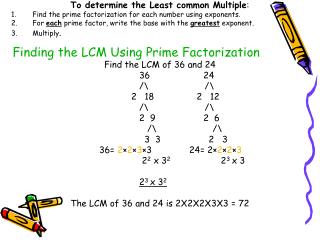
This guide explains how to calculate the Least Common Multiple (LCM) using prime factorization. We walk through examples with numbers like 12 and 20, demonstrating the breakdown into prime factors (e.g., 12 = 2x2x3, 20 = 2x2x5). By identifying common pairs, we find the LCM by multiplying the highest powers of all prime factors involved, leading to results like 60 for LCM(12, 20) and 36 for LCM(12, 18). The process clarifies the relationship between the LCM and the Greatest Common Factor (GCF) for a deeper understanding of number theory.

10 LCM using Primes
E N D
Presentation Transcript
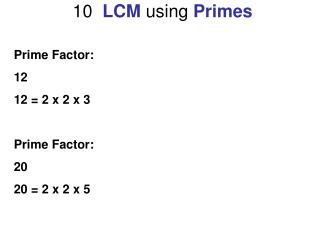
10 LCM using Primes Prime Factor: 12 12 = 2 x 2 x 3 Prime Factor: 20 20 = 2 x 2 x 5
12 = 2 x 2 x 3 LCM(12,20) = What’s left behind? 20 = 2 x 2 x 5 Make common pairs 2 x 2 x 3 x 5 = 60 GCF LCM
Example 12 = 2 x 2 x 3 LCM(12,18) = What’s left behind? 18 = 2 x 3 x 3 Make common pairs 2 x 3 x 2 x 3 = 36 GCF LCM
Example 18 = 2 x 3 x 3 LCM(18,20) = What’s left behind? 20 = 2 x 2 x 5 Make common pairs 2 x 3 x 2 x 3 x 5 = 180 GCF LCM