Understanding Floating-Point Representation and Arithmetic in Computing
This article explores the principles of floating-point representation and arithmetic in computing, focusing on the IEEE standard for binary representation. It discusses fixed-point notation, how floating-point format allows representation of real numbers with fractions, and the constraints of value representation using 32 bits. Additionally, it covers basic operations in floating-point arithmetic, such as addition and subtraction, and the importance of exponent alignment to ensure accurate calculations, including handling exponent overflow, underflow, and significand adjustments.

Understanding Floating-Point Representation and Arithmetic in Computing
E N D
Presentation Transcript
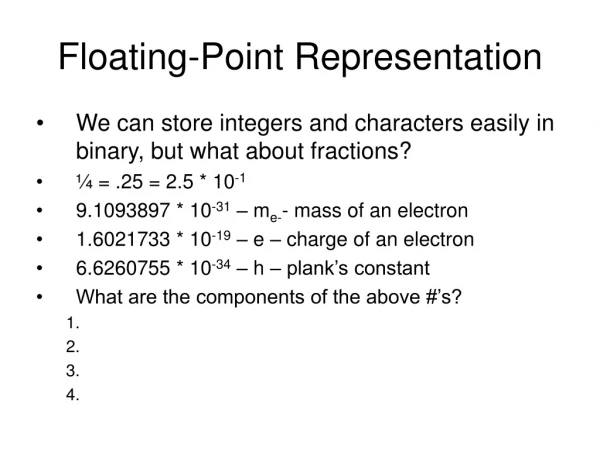
9.4 FLOATING-POINT REPRESENTATION • With a fixed-point notation (e.g., twos complement) it is possible to represent a range of positive and negative integers centered on 0. By assuming a fixed binary or radix point, this format allows the representation of numbers with a fractional component as well. • It is important to note that we are not representing more individual values with floating-point notation. • The maximum number of different values that can be represented with 32 bits is still
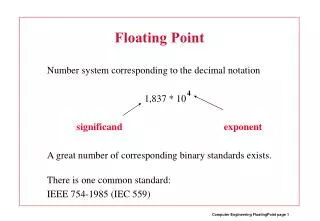
This number can be stored in a binary word with three fields: Sign: plus or minus Significand S Exponent E
IEEE Standard for Binary Floating-Point Representation • The IEEE standard defines both a 32-bit single and a 64-bit double format with 8-bit and 11-bit exponents • Figure 9.21 the standard defines two extended formats, single and double
9.5 FLOATING-POINT ARITHMETIC • Table 9.5 summarizes the basic operations for floating-point arithmetic. • For addition and subtraction it is necessary to ensure that both operands have the same exponent value. - Exponent overflow: A positive exponent exceeds the maximum possible exponent value. - Exponent underflow: A negative exponent is less than the minimum possibleexponent value - Significandunderflow: - Significand overflow:
Addition and Subtraction • Check for zeros • Align significands (adjusting exponents) • Add or subtract significands • Normalize result