Download
1 / 17
170 likes | 278 Views
This lecture by Steve Maybank at Birkbeck College, U. London, explores critical concepts in computer systems, specifically focusing on number representations. Participants revisit the meaning of programs, how they interact with memory cells, and the execution of instructions. The lecture covers variable definitions and algorithms, as well as detailed explorations of different number representations such as excess notation and two’s complement. Practical examples and exercises, including conversions and arithmetic operations, illustrate these concepts, enhancing understanding of how integers are represented in computing.

E N D
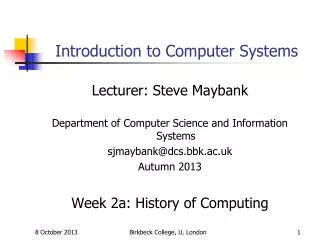
Introduction to Computer Systems Lecturer: Steve Maybank Department of Computer Science and Information Systems sjmaybank@dcs.bbk.ac.uk http://www.dcs.bbk.ac.uk/~sjmaybank Autumn 2014 Week 3a: Number Representations Birkbeck College, U. London
Recap: Programs • A program is a sequence of instructions. • The instructions may refer to memory cells which store values such as integers. • In Tom’s computer the memory cells are the boxes. • Each memory cell has an address and contents. Birkbeck College, U. London
Recap: Running a Program • The instructions of the program are executed one by one. • When an instruction is executed, the values in the memory cells may change. • When the program halts the output is usually the values of selected memory cells. Birkbeck College, U. London
Recap: Variables • Here are two typical statements in a programming language: p = 0; q = 3+4; • Left hand side: the name of a variable • Right hand side: an expression • Execution: evaluate the right hand side to obtain a number. Store the number in a memory location named by the variable. Birkbeck College, U. London
Exercise from Week 2 • Sketch an algorithm that takes as input a strictly positive integer n and outputs an integer k such that Birkbeck College, U. London
Representations of Negative Integers • Put a minus sign in front of the representation for a positive integer. • Excess notation. • Two’s Complement notation – the most popular representation for integers in computers. Brookshear, Section 1.6
Excess Notation • Problem: represent a set of positive and negative integers using bit strings with a fixed length n. • Represent 0 by 10…0 (n bits). • Represent positive numbers by counting up from 10…0 in standard binary notation. • Represent negative integers by counting down from 10…0 in standard binary notation. Brookshear, Section 1.6
Example of Excess Notation n=3 111 3 110 2 101 1 100 0 011 -1 010 -2 001 -3 000 -4 Brookshear, Section 1.6
Examples • Find the 6 bit excess notation for the decimal numbers 7 and -6. • Which decimal number has the 5 bit excess notation 10101. Birkbeck College, U. London
Two’s Complement Notation • Form the bit string 10…0 with n+1 bits. • Represent 0 by the rightmost n bits of 10…0. • Represent positive integers by counting up from 10…0 in standard binary notation and using the rightmost n bits. • Represent negative integers by counting down from 10…0 in standard binary notation and using the rightmost n bits. Birkbeck College, U. London
Examples Birkbeck College, U. London
Example of Two’s Complement Notation 0111 7 0110 6 0101 5 0100 4 0011 3 0010 2 0001 1 0000 0 1111 -1 1110 -2 1101 -3 1100 -4 1011 -5 1010 -6 1001 -7 1000 -8 n=4 The left most bit indicates the sign. Brookshear, Section 1.6
Addition and Subtraction • In the two’s complement system subtraction reduces to addition. • E.g. to evaluate 6-5 in 4 bit two’s complement notation, add the tc bit strings for 6 and –5, then take the four rightmost bits. 0110 6 1011 -5 === == 10001 1 Brookshear, Section 1.6
Explanation • The bit strings for TC[6] and TC[-5] are the rightmost four bits of Binary[24+6] and Binary[24 -5], respectively. • The bit strings TC[6], TC[-5] are added as if they were binary numbers. The rightmost four bits of the result equal the rightmost four bits of Binary[(24+6)+(24-5)]= Binary[24+24 +1]. • The right most four bits of Binary[24+24 +1] are the bit string for TC[1]. Brookshear, Section 1.6
Why Use Two’s Complement • Addition and subtraction require one circuit for addition and one circuit for negation. • This is more efficient than having a circuit for addition and a circuit for subtraction. Brookshear, Section 1.6
Two’s Complement Notation for m and -m • Suppose TC[m] = s || 1 || t, where t is a string of zeros. • Then TC[-m]=Complement[s]||1||t. • Proof: the rightmost n bits of TC[m]+TC[-m] are all zero. • Example: n=4, TC[3]=0011, TC[-3]=1101. Brookshear, Section 1.6
Example • Find the 5 bit two’s complement representations for the decimal integers 5 and -5. Birkbeck College, U. London