Deep Dive into React States From Imperative to Declarative Programming 2024
0 likes | 5 Views
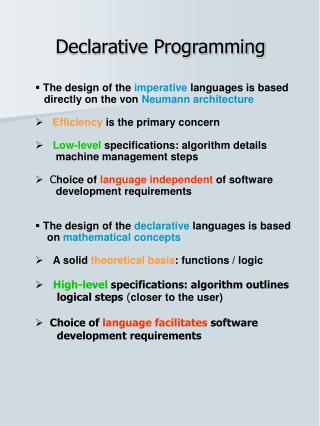
Modern JavaScript frameworks such as KnockoutJs, AngularJS, VueJs, and ReactJs were developed to shift from imperative to declarative programming. Covalensedigital is at the forefront of helping businesses embrace the shift from imperative to declarative programming paradigms


Deep Dive into React States From Imperative to Declarative Programming 2024
E N D
Presentation Transcript
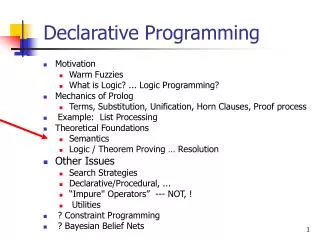
Deep Dive into React States From Imperative to Declarative Programming The evolution from imperative programming with vanilla JavaScript to modern JavaScript frameworks has revolutionized UI development. Imperative programming required detailed instructions to manipulate the UI, making it inefficient and difficult to scale as projects grew in complexity. Managing highly complex frontend projects was nearly impossible. Modern JavaScript frameworks such as KnockoutJs, AngularJS, VueJs, and ReactJs were developed to shift from imperative to declarative programming. These frameworks allow programmers to specify what should be displayed, leaving the complex task of rendering to the framework. This shift enabled developers to focus on business logic, making it feasible to build and manage highly complex frontend applications. React: A Modern JavaScript Framework React is a popular and versatile JavaScript framework. It is unopinionated, meaning it provides tools and methodologies but leaves the implementation details to the developer. Components in React Components are the building blocks of a React application. A React app is divided into smaller, manageable, and maintainable pieces of code. Components have two key aspects: props and state. Props: Passes from a parent to a child component, props are read-only.
State: Internal to the component and immutable, state can be changed using the setter function. Any change in state causes the component to re-render. Principles of Structuring State 1.Group Related State: Combine related states. For example, instead of having separate states for longitude and latitude, combine them into a single state representing coordinates. 2.Prevent State Contradictions: If two states are interdependent and some combinations are impossible, derive one state from the other to avoid contradictions. 3. Eliminate Redundant State: If information can be calculated from props or component state, avoid adding it to the component state. 4.Avoid State Duplication: Duplication of data across multiple variables can cause synchronization issues. Maintain a single source of truth. 5. Minimize Nested State: Deep hierarchies are challenging to update. Prefer a flat state hierarchy whenever possible. Sharing State Between Components When state needs to be shared between components, lift the state to the closest common parent and pass it down via props. This technique is known as state lifting in React. Extracting State Logic to Reducers Managing numerous states and updating them through various event handlers can become complex. Extracting state update logic into a reducer, facilitated by the `useReducer` hook, helps manage this complexity. Prop Drilling As components grow in complexity, passing props through multiple levels becomes cumbersome. This practice is known as prop drilling. To address this, use React’s context. Context allows you to inject data at a higher level and access it in any child component without passing props through each level. Combining Reducer and Context API
For effective management of a complex screen, combine the use of reducers and context. A reducer consolidates state update logic, while context allows you to pass data to deeply nested components without props. Inject the data via context at the root level, exposing both the data and the dispatch function to update the state. At Covalensedigital, we are at the forefront of helping businesses embrace the shift from imperative to declarative programming paradigms. Leveraging cutting-edge technologies like React into our Product and services offering, we empower our clients to experience products that are scalable, efficient, and maintainable. By focusing on modern development practices, we enable seamless transformation, allowing businesses to deliver superior user experiences. Our expertise in state management, component-driven architectures, and declarative UIs ensures that our clients stay ahead in an ever-evolving digital landscape, driving innovation and growth. Visit: Covalense Digital LinkedIn