The Warsaw Ghetto: Resilience and Resistance Amidst Unimaginable Hardship
Established on October 16, 1940, the Warsaw Ghetto was a grim space for around 400,000 Jews rounded up by the Nazis. Led by Adam Czerniaków, who sought collaboration over revolt, the ghetto faced dire conditions: with Jews limited to an average of 186 calories a day while Germans received 2,614. Despite starvation and unemployment, cultural and educational life thrived underground. After several months of relative calm, a violent deportation on January 18, 1943, led to significant resistance, ultimately crushed by mid-May, resulting in tens of thousands killed or deported to death camps.

The Warsaw Ghetto: Resilience and Resistance Amidst Unimaginable Hardship
E N D
Presentation Transcript
war saw Ghetto A town where they put the jews
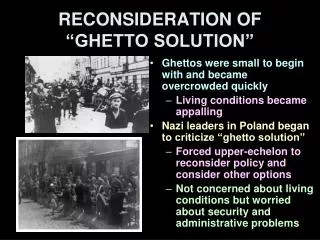
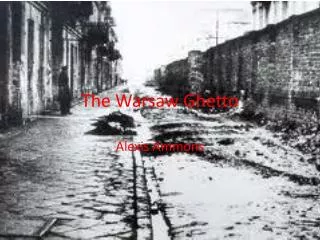
The Warsaw Ghetto was established by the German governor general Hans on October 16, 1940. Frank ordered Jews in war saw and its suburbs rounded up and herded into the Ghetto. At this time, the population in the Ghetto was estimated to be 400,000 people, In Warsaw this role was attributed to adamczerniakona who chose a policy of collaboration with the Nazis rather than revolt. Adam Czerniaków confided his harrowing experience in several diaries. He became aware of his own tragic duplicity in July 1942 and committed suicide.
Average food rations in 1941 for Jews in Warsaw were limited to 186 calories. and 2,614 calories for Germans Unemployment was a major problem in the ghetto. Illegal workshops were created to manufacture goods to be sold illegally on the outside and raw goods were smuggled in often by children.
Smuggling was often the only source of subsistence for Ghetto inhabitants, who would otherwise have died of starvation. Despite the grave hardships, life in the Warsaw Ghetto was rich with educational and cultural activities, conducted by its underground organizations On January 18, 1943, after almost four months without any deportations, the Germans suddenly entered the Warsaw ghetto intent upon a further deportation. Within hours, some 600 Jews were shot and 5,000 others rounded up.
Significant resistance ended on April 23, and the Nazi operation officially ended in mid-May, symbolically culminated with the demolition of the great synagogue of war saw on May 16. According to the official report, at least 56,065 people were killed on the spot or deported to German Nazi concentration and death camps, most of them to Treblinka.<- (death camp)