Recent Neutrino Physics Findings: AMANDA Experiment Results and Future Prospects
170 likes | 269 Views
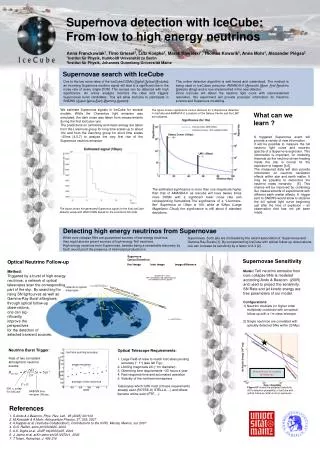
Delve into the latest advancements in neutrino physics with insights from the AMANDA experiment at the South Pole. This presentation highlights studies on atmospheric backgrounds, AGN, GRBs, and more. Explore detection strategies, event selection optimizations, and dark matter searches. Learn about limits, sensitivities, and unfolded spectra. Discover how AMANDA's achievements pave the way for the IceCube project and the future of astroparticle physics.


Recent Neutrino Physics Findings: AMANDA Experiment Results and Future Prospects
E N D
Presentation Transcript
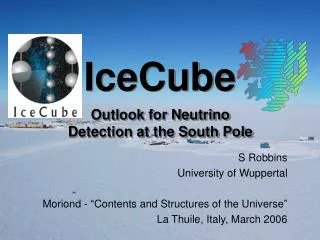
Julia Becker for the IceCube collaboration Neutrino Physics at the South Pole:Recent results from the AMANDA experiment
Sweden: Uppsala Universitet Stockholm Universitet UK: Imperial College Oxford University Netherlands: Utrecht University Japan: Chiba University Belgium: Université Libre de Bruxelles Vrije Universiteit Brussel Universiteit Gent Université de Mons-Hainaut New Zealand: University of Canterbury Antarctica: Amundsen Scott South Pole Station AMANDA IceCube Germany: Humboldt Universität Universität Mainz DESY-Zeuthen Universität Dortmund Universität Wuppertal Universität Berlin
p gD…pn... N ...m, casc
Diffuse Neutrino Spectra • Atmospheric Bg • Extragalactic: • AGN (1) (Becker/Biermann /Rhode) • AGN (3 and 4) (Mannheim /Protheroe/Rachen) • GRBs (2) (Waxman/Bahcall)
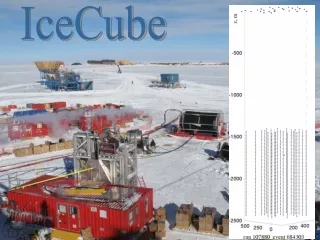
AMANDA/IceCube 677 PMTs on 19 strings Cherencov light South Pole Dome road to work AMANDA Summer camp 1500 m Amundsen-Scott South Pole Station 2000 m [not to scale]
Detection Strategies • Presented in this talk: • Diffuse search • Steady Point sources • Transient objects (AGN flares & GRBs) • WIMPs • plus: • SN in our galaxy • Cosmic Ray Composition • Atmospheric muon spectrum • Search for magnetic monopoles • Galactic Plane
Diffuse energy spectrum • Unfolding the energy spectrum • Data follow atmospheric prediction • Energy spectrum up to 100 TeV • Limit on E-2 extragalactic flux:
Diffuse limits and sensitivities • Unfolded spectrum • 4yr sensitivity • All flavor limits: • Cascades • Ultra High Energies • IceCube
Single sources 3329 events (2000-2003), mostly atm. neutrinos, < 5% atm. muons no point source signal seen so far • Improved background rejection by new pattern recognition method • Blindness strategy: Event selection optimized with randomized RA • Sensitivity (90% C.L.):~ above 10 GeV
Stacking of sources (year 2000) single source sensitivity (4yrs)
AGN flares Mkn421, year 2000 • Sliding window:12 sources tested, no significant excess • Multi-wavelength: 3 of the 12 sources, no excess
GRBs – average spectrum years #(GRB) selection criteria limit/sens. 97-00 312 BATSE 4e-8 00-03 139 BATSE& IPN 3e-8 01 - diffuse search 2.7e-6 Preliminary 00 74 BATSE 9.5e-7
Average Individual b b-2 a
GRBs – Individual Spectra Model Sensitivity [GeV/s/cm2] Limit [GeV/s/cm2] isotropic 0.157 0.150 beamed 0.041 0.039 average (WB) 0.036 0.035 • Waxman/Bahcall: average spectrum • Single spectrum approach • GRB030329: • Individual par. (model 1,2) • average par. (model 3)
Indirect WIMP search excluded by CDMS Results (2001) for solar WIMPs • Dark matter accumulates in high density regions • Earth and Sun: annihilation of WIMPs in the center • If flux from there WIMPS • Signal expectation: use Monte Carlo (DARKSUSY) • No significant excess above background, limit on muon flux hard channel: ccW W + -
Summary • AMANDA is an operating UHE neutrino telescope • Different search strategies: • Diffuse search, spectrum up to 100 TeV • Steady point sources (single sources & stacking) • Transient sources (flares and GRBs) • Dark matter search • …and more… • Analyses show so far no signal above atmospheric flux • Constraints on current models possible • Future: IceCube