Vertebrates
This overview delves into the seven major phyla of vertebrates, highlighting their distinct characteristics. Jawless fish feature round mouths and cartilaginous skeletons, while cartilaginous fish possess movable jaws and gill slits. Bony fish are identified by scales and bony skeletons. Amphibians exhibit smooth, moist skin and are capable of living both in water and on land. Reptiles have dry, scaly skin and lay shelled eggs. Birds and mammals are characterized by their adaptations for aerial and terrestrial life, respectively, including feathers and hair.


Vertebrates
E N D
Presentation Transcript
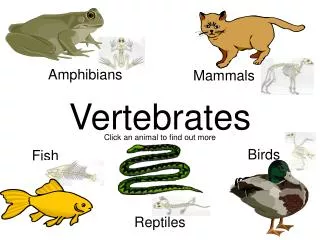
Seven Phylum • Jawless Fish • Cartilaginous Fish • Bony Fish • Amphibians • Reptiles • Birds • Mammals
Jawless Fish Round mouth; tubelike body; scaleless skin; cartilage skeleton
Movable jaw, scales, cartilage skeleton, gill slits Cartilaginous Fish
Bony Fish • Movable jaw, scales, boney skeleton, covered gills
Smooth, moist skin; no scales; most have lungs and a 3 chambered heart; live in water and on land Amphibians
Reptiles • Dry, tick skin; scales; lungs; lay shelled eggs on land; 3 or 4 chambered
Birds • Dry, tick skin; scales; lungs; lay shelled eggs on land; 3 or 4 chambered
Mammals • Hair; mammary glands; specialized teeth; most produce live offspring
Animal Characteristics • Eat other organisms • Many-celled organisms • Eukaryotic cells • Move about • Digest their food
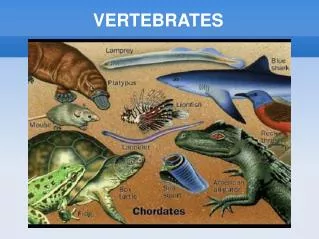
Phylum Chordates • Notochord • Hollow nerve cord • Gill slits • Bilateral Symmetry
Vertebrates • Endoskeleton • Cartilage