Osteological Indicators of Prehensility in Theria: Fossil Taxa Identification and Evolutionary Insights
This study explores the osteological indicators of prehensility in Theria, focusing on the evolutionary adaptations observed in fossil taxa. By analyzing features such as tail length, vertebral structure, and robusticity, the research identifies multiple origins and convergent evolution of prehensility across six orders. The findings provide a comprehensive framework for recognizing prehensility in prehistorical specimens, highlighting its significance in evolutionary biology. Key indicators include the long proximal section of the tail and well-developed transverse processes, found across various fossil records.

Osteological Indicators of Prehensility in Theria: Fossil Taxa Identification and Evolutionary Insights
E N D
Presentation Transcript
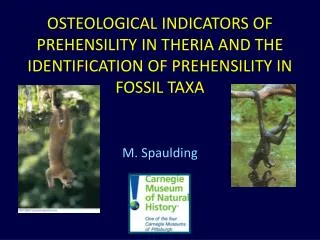
OSTEOLOGICAL INDICATORS OF PREHENSILITY IN THERIA AND THE IDENTIFICATION OF PREHENSILITY IN FOSSIL TAXA M. Spaulding
Prehensile Semi-Prehensile ?
Minimum 8 events In 6 orders
Previous Work Carnivorans Primates
Proximal region From 1st caudal to transitional Transitional region After transitional to longest caudal Distal region After longest caudal Tail Terminology 3 regions of the tail
Transitional Vertebra Proximal Transitional
Proximal region From 1st caudal to transitional Transitional region After transitional to longest caudal Distal region After longest caudal Tail Terminology 3 regions of the tail
Phylogenetically Independent Osteological Indicators • Long tail compared to body • Long proximal section • Short transitional section • Well developed transverse processes • Increase in robusticity • Sacral features • Number of vertebrae touching pelvis • Size of sacral foramen
Tail Length Percentage of body length
Relative Section Lengths Proximal Transitional
Proximal Section % minus Transitional Section % (% of body length)
Robusticity of distal caudals Robusticity Percent of tail length
Phylogenetically Independent Osteological Indicators • Long tail compared to body • Long proximal section • Short transitional section • Well developed transverse processes • Increase in robusticity • Sacral features • Number of vertebrae touching pelvis • Size of sacral foramen
Green River Formation, Wyoming 52.5 Ma “cimolestid” Spaulding et. al 2008 Spaulding, Flynn, and Grande. In prep.
Tail Length Section Lengths
Robusticity of distal caduals Robusticity Percent of tail length
Its Prehensile! • 51 caudal vertebrae! • Long proximal section compared to transitional • Well developed distal transverse processes • Increase in robusticity
Conclusions • Suite of features for identifying prehensility in fossils identified. • Features both applicable intra and inter ordinally • Identification of prehensility in fossil ‘cimolestid’
Acknowledgements • Access to collections and specimens: Carnegie Museum of Natural History - Dr. Zhe-xi Lou, Alan Tabrum, and Amy C. Henrici; The Field Museum of Natural History - Dr. Lance Grande and William F. Simpson; AMNH: Ivy Rutzky, Carl Mehling, Dr. Chris Norris, Ruth O’Leary, Judy Galkin, and Susan Bell. Eileen Westwig, Darrin Lunde, Neil Duncan, Catherine Doyle-Capitman, and Dr. Robert Voss, Ana Barcel, Jeanne Kelly, Amy Davidson, Dr. Robert Evander, JustyAlicea, Edward Pedersen, Lorraine Meeker, and Chester Tarka. • Funding: Columbia University and the National Science Foundation, NSF Graduate student fellowship and two awards to J. Flynn