Download
1 / 14
140 likes | 261 Views
This exploration delves into the significance of names as symbolic communication and their influence on personal and cultural identity. It examines the practical functions of language, such as controlling, informing, and expressing emotions. Key issues like euphemisms, jargon, hate speech, and gender differences in communication styles are discussed. The concepts of code-switching and the Sapir-Whorf hypothesis present a thought-provoking angle on how language shapes our worldview and thought processes. The interplay between language and gender further uncovers conversational dynamics in social contexts.

E N D
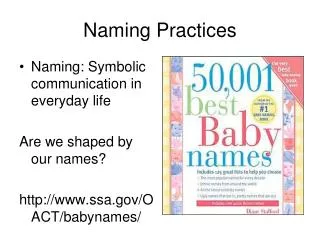
Naming Practices • Naming: Symbolic communication in everyday life Are we shaped by our names? http://www.ssa.gov/OACT/babynames/
Functions of language • To control • To inform • To Express Feelings • To Express Creativity • Ritual
Some word problems • Abstract words (‘unlikely”, “cheap”, “Long”) • Euphemisms (‘collateral damage’) • Equivocation—deliberately vague • Jargon (technical) • Slang (informal, nonstandard) • Hate speech (often uncivil)
Labels and Biased Language Sexist Racial/ethnic Politically correct language Marked vs. Unmarked terms (i.e. “male nurse”, “adopted child” “gay friend”)
Language in Context • Relational (ex: label for significant other?) • Situational (high vs. low language) • Cultural (language influences worldview) • Code-switching/style switching (accommodation)
Does language constrain thought? Can different cultures with different words think different things? Savoir-faire, Schadenfreude, amae Hopi=no difference between noun/verb Sapir-Whorf Hypothesis: language both shapes and is impacted by culture
Gender & Language • Is this == True? • Problems? • “Report talk vs. “Rapport talk”
Gender Differences in Conversations • Reasons for talk • Women=“need” to talk, social support • Men=accomplish tasks, advice, info • Style differences • Women=questioning, accommodating, expressive. Use Intensifiers and Qualifiers/tag questions more • Men=interrupt more, assertive,