Enhancing Market Efficiency and Welfare through Effective Competition Policy
This document explores the critical role of competition policy in promoting efficiency and optimizing welfare in markets. It emphasizes the importance of market discipline, the need for government regulation in cases of market imperfections, and the objectives of competition policy such as promoting competition, disciplining errant firm behavior, and ensuring consumer protection. Major areas of focus include anti-trust laws, regulation of natural monopolies, and the management of mergers and acquisitions. A competition culture is vital for improving market dynamics and ensuring fair competition.


Enhancing Market Efficiency and Welfare through Effective Competition Policy
E N D
Presentation Transcript
Understanding Competition Policy Erlinda M. Medalla April 27-28, 2006 Hanoi
Enhancing efficiency and optimizing welfare • In general, market discipline (where there is effective competition) leads to efficiency and welfare optimization • In certain cases, there is need to discipline the market– where there are deviations from competition due to errant firm behavior • Cases of inherent market imperfection– where there is need for government regulation to achieve competitive-like outcomes
What is competition policy for? • Promoting (effective) competition • Making markets contestable • Discipline errant firm behavior (restrictive business practices) • And where market fails (natural monopolies) enforcing competition rules (regulation) to produce competitive-like outcomes Objective: eliminate rents and maximize overall welfare
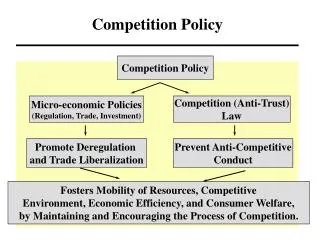
Major areas of competition policy • Anti-trust law governing firm behavior to ensure fair competition • Abuse of dominant position, restrictive agreements, M&A • Consumer protection (from unfair competition practices) • Regulation of natural monopolies • Review of government policies impinging on competition
Competition and Regulation Competition law to govern: • Restrictive trade practices arising from: • Abuse of dominant position • Agreements • Mergers and acquisition • Consumer protection- unfair trade practices Regulation of natural monopolies
Types of Restrictive Business Practices • Exclusionary abuse • Deliberate act of the firm (or group of firms) to exclude potential firms from entering the market by means other than becoming more efficient. • Exploitative abuse • Abuse of market power where firms would limit outputs thru some deliberate means in order to increase prices and extract monopoly rents.
Examples of Restrictive Business Practices Exploitative abuse; • Cartel Agreements to fix prices, outputs • Agreement to divide markets • Collusive tendering (bid rigging) • Predatory pricing Exclusionary abuse: • Resale price maintenance, • Exclusive dealing, tying sales, designed to limit competition from rival firms
What needs to be done? • Creating a “competition culture” • Belief in markets and willingness to be subject to market discipline • Awareness of rights and knowledge about anti-competitive acts • “Profit with honor” • Capacity building • Crafting a “good” competition law • a “living” law conducive to developing national competition authority which is respected and credible.
No one unique model • US- Strong anti-trust law enforcement and sector regulation • Europe- the mandate driven division of labor between sector regulators and competition authorities • Korea- coordination between KFTC and sector regulator– same competition principles • Australia- integration of regulation and antitrust
Key elements of competition law • Clear definitions • Clear rules to identify prohibited actions (e. g. per se prohibitions),& appropriate remedies and/or penalties • Rules on mergers & acquisitions • Research function and Investigative powers • Independent competition authority?
Key elements of competition law • Mechanism for reviewing existing (and proposed) government policies & regulations as they impact on competition • Provisions for transition– • Capability building • Start small • Relationship between competition authority and sector regulators • Education, information and advocacy functions
Some major concerns at early stages • Ensuring that it would not be just another regulatory layer • Provisions on prohibited acts— • How to be crafted to lessen ambiguity • On implementing body— • How to create a credible, respected authority • Need for learning period and capability building • Need for information, education & advocacy