The Evolution of Still Life: A Journey Through Art History
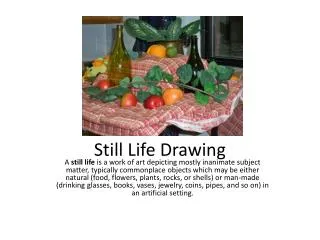
Explore the rich history of still life drawing, a genre that began over 3,000 years ago with tomb depictions in Egypt. From early studies of nature by artists during the Renaissance and 18th-century masterpieces showcasing wealth, to modern interpretations in Impressionism, Cubism, and Photo Realism, still life reflects human contemplation of life, beauty, and fragility. Discover the transformation of this art form through renowned works by Floris van Dijck, Jan Davidsz. de Heem, Vincent Van Gogh, and more, showcasing diverse techniques and inspirations.

The Evolution of Still Life: A Journey Through Art History
E N D
Presentation Transcript
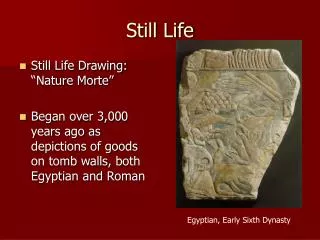
Still Life • Still Life Drawing: “Nature Morte” • Began over 3,000 years ago as depictions of goods on tomb walls, both Egyptian and Roman Egyptian, Early Sixth Dynasty
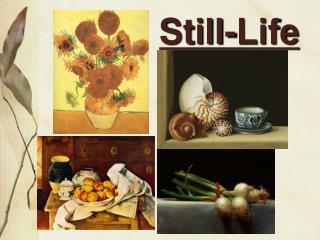
15th Century-Renaissance • Artists began a studious contemplation of plants, animals, elaborate jewels and drapery • Showed life and growth in painting Floris van Dijck, Still Life with Cheeses
16th Century • Still Life began to show the frailness of life • Depictions of rotting food and dead animals
17th Century-Netherlands • Still life drawings showed bountiful displays of food, cutlery, mouthwatering scenes • Commissioned to show wealth and hobbies Jan Davidsz. de Heem Still Life with a Glass and Oysters, 1640
18th Century • Still life scenes brought to perfection by artists such as Raphaelle and James Peale James Peale, Still Life with Fruit, 1824
19th Century • Beginning of Trompe L’oeil (Fool the Eye) • Emphasis was no longer on the subject, but on the point of view • Illusion of Reality William Harnett, Violin 1894
20th Century • Beginning of various art movements: Impressionism Cubism Expressionism Fauvism Photo Realism • Each movement used still life in its own manner Henri Matisse, Fauvist Movement Blue Still Life, 1907
Impressionistic Still Life • Impressionists used subject to show the effects of light • Blended colors in a “painterly” style Claude Monet Flowers in a Vase
Expressionistic Still Life • Expressionists used still life subject to show emotion • Thick, heavy brushstrokes Vincent Van Gogh Still Life with a Bouquet of Daisies
Cubistic Still Life • Cubist movement broke objects down to their most basic shapes • Abstracted everyday items and rearranged parts Juan Gris, 1916 Fruit Dish, Glass and Lemon
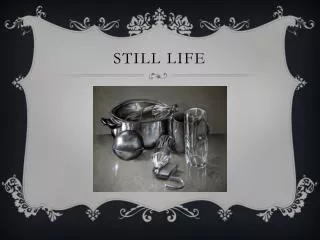
Photo Realism Still Life • Photo Realists attempted to recreate a subject to the most precise detail. • Objects such as glass or metal were often used because of the intense precision Janet Fish Stack of Plates, 1980
Janet Fish Green Tea Cup, 1997 Vase, 1999