Neural Network Optimization Techniques Overview
Understand key concepts like weight initialization, learning rates, overfitting, gradient descent, and ensemble learning for effective neural network optimization. Discover strategies to avoid common pitfalls in model training.

Neural Network Optimization Techniques Overview
E N D
Presentation Transcript
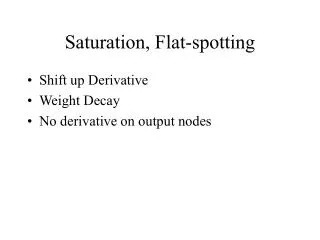
Saturation, Flat-spotting • Shift up Derivative • Weight Decay • No derivative on output nodes
Weight Initialization • Can get stuck if initial weights are 0 or equal • If too large - node saturation from f’(net) • If too small - very slow due to propagation back through weights • Usually small Gaussian distribution around a 0 mean • C/square-root(fan-in) • Background knowledge
Learning Rate • Very unstable for high learning rates (typical .1 - .25) • Can estimate optimal if calculate the Hessian - 1/max eigenvalue of the Hessian • Larger rate for hidden nodes • Rate divided by fan-in - more equitable rate of change across nodes • Learning speed vs. Generalization accuracy
Adaptive Learning Rates • Local vs. Global - start small • Increase LR when error is consistently decreasing (long valleys, smooth drops, etc.) - stop when gradient is changing (non-smooth areas of error surface) - decrease (rapidly) when error begins to increase • C(t) = 1.1C(t-1) if E(t) < E(t-1) • C(t) = .9C(t-1) if E(t) < E(t-1) - often a fast non-linear drop-off • C(t) = C(t-1) if E(t) ~ E(t-1) • Second derivative of error • Sign change in derivative
Momentum • Amplifies effective Learning rate when there is a consistent gradient change • Helps avoid cross-stitching • Can avoid local minima (for better or for worse)
Generalization/Overfitting • Inductive Bias - small, similarity, critical variables, etc. • Optimal model/architecture • Neural Net - tendency to build (from simple weights) until sufficient, even though large, vs. a pre-set polynomial, etc. • Holdout set - keep separate from Test set • Stopping criteria - especially w/constructive • Noise vs. Exceptions • Regularization - favor smooth functions • Jitter • Weight Decay
Empirical Testing/Comparison • Proper use of Test/hold-out sets • Tuned algorithm problem • Cross-Validation - small data, which to use • Statistical Significance • Large cross-section of applications
Higher Order Gradient Descent • QuickProp • Conjugate Gradient, Newton Methods • Hessian Matrix • Less iterations, more work/iteration, assumptions about error surface • Levenberg-Marquardt
Training set/Features • Relevance • Invariance • Encoding • Normalization/Skew • How many - curse of dimensionality - most relevant, PCA, etc. • Higher order - Combined algorithms, feature selection, domain knowledge
Training Set • How large • Same distribution as will see in future • Iteration vs. Oracle • Skew • Error Thresholds • Cost function • Objective functions
Constructive Networks • ASOCS • DMP - Dynamic Multilayer • Convergence Proofs - Stopping criteria • Cascade Correlation • Many variations • BP versions - node splitting
Pruning Algorithms • Drop node/weight and see how it effects performance - Brute force • Drop nodes/weights with least effect on error • Do additional training after each prune • Approximate the above in a parsimonious fashion • First and second order error estimates for each weight • Penalize nodes with larger weights (weight decay) - if they are driven close to 0 then can be dropped • If output is relatively constant from a node • If output of multiple nodes correlate (redundant)
Learning Ensembles • Modular Networks • Stacking • Gating/mixture of experts • Bagging • Boosting • Different input features – if many/redundant • Injecting randomness – initial weights, change parameters of learning alg stochastically – (just a mild version of using different learning algs) • Combinations of the above • Wagging • Mimicking