Comprehensive Science Essential Standards and Assessment Strategies
This document outlines essential science standards, organized into three strands: Physical Science, Earth Science, and Life Science. It covers fundamental concepts, including forces and motion, matter properties, energy conservation, and ecosystems. Instructional toolkits and formative assessment probes are included, emphasizing diverse scientific investigation approaches. Resources for professional development and science literacy are provided to aid educators in supporting student learning. The document also details science test information, weight distributions, and various types of assessment items.

Comprehensive Science Essential Standards and Assessment Strategies
E N D
Presentation Transcript
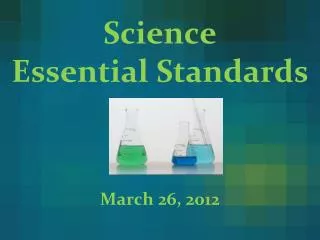
Science Essential Standards March 26, 2012
Part I:Introduction Shanda Childers-John Lawrence Danielle Kesler-Crays Chapel Lora Krpejs-Hopewell Niki Meadows-Tabernacle Tangye Strickland-Farmer Anna Watts-Franklinville Frankie Younts-Archdale
Essential Standards • Organized into 3 strands • Physical Science (P) • Earth Science (E) • Life Science (L)
Unifying Concepts • Forces and Motion • Matter, Properties and Change • Energy: Conservation and Transfer • Earth Systems, Structures, and Processes • Earth History • Structures and Functions of Living Organisms • Ecosystems • Evolution and Genetics • Molecular Biology
Essential Standards • Instructional Toolkits • Under development • Include: • Crosswalk documents • Unpacking documents www.ncpublicschools.org/acre/standards/support-tools/
Formative Assessment Probes • Complete the “Doing Science” probe • Decide which student you agree with and explain your reasoning • Discuss your reasoning with a partner
Put X next to living things _____Tree _____Rock _____Fire _____Boy _____Wind _____Rabbit _____Cloud _____Feather _____Grass _____Mushroom _____Potato _____Leaf _____Butterfly _____Pupae _____Bear Is it Living? Explain your thinking. What “rule” or reasoning did you use to decide if something could be considered living?
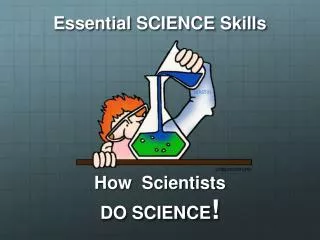
Doing Science Probe • Purpose: • Elicit students’ ideas about scientific investigations • Scientists investigate the world in a variety of ways depending on the question they pose. • Observations, models, experiments, and collecting specimens • There is no fixed sequence of steps that all scientists use and follow rigidly.
Suggestions for Instruction • Provide students with a variety of ways to do science • Use caution when using the word experiment (controlling variables); use investigation • Use caution when referring to the scientific method (a scientific method) • Expose students to different types of scientists, areas of science, and science investigations
Essential Standards • Instructional Toolkits • Under development • Include: • Crosswalk documents • Unpacking documents www.ncpublicschools.org/acre/standards/support-tools/
Essential Standards Resources • DPI Wiki Space http://www.ncdpi.wikispaces.net/ • Webinars • Support Packs • Resources
Essential Standards Resources • Science Literacy Maps http://nsdl.org/ • Benchmarks for Science Literacy http://www.project2061.org/publications/bsl/default.htm
Science Tests • Designed for online administration (with paper/pencil version available) • Weight Distributions • Forces and Motion 13–15% • Matter: Properties and Change 12–14% • Energy: Conservation and Transfer 11–13% • Earth Systems, Structures, and Processes 15–17% • Structures and Functions of Living Organisms 14–16% • Ecosystems 14–16% • Evolution and Genetics 13–15% • Types of Items: • Multiple Choice • Technology-Enhanced Items http://www.ncpublicschools.org/acre/assessment/online/