Understanding Congruences and Residue Systems in Number Theory
This text delves into the concepts of congruences in number theory, defining the relationship between integers based on divisibility. It discusses complete and reduced residue systems, illustrating with examples like the complete residue system modulo 8 and 6. Additionally, it covers Euler’s function and Fermat's theorem, emphasizing their significance in determining properties of integers concerning prime numbers. This foundational understanding of residues and congruences is crucial for advanced studies in number theory.

Understanding Congruences and Residue Systems in Number Theory
E N D
Presentation Transcript
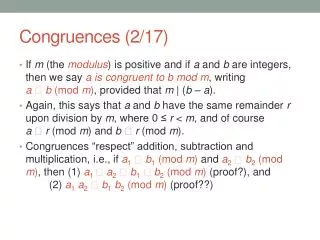
同餘 Congruences • Definition If an integer m, not zero, devides the difference a-b, we say that a is congruent to bmodulo m and write . • .
三式等價。 • 則。 • 則。 • 則。 • 則。 • 則 對任意都成立。
若f是一個整係數多項式,且,則 • Ex : , , ,
若且唯若 . • , , 則 . • for , 若且唯若 .
Definition If , then y is called a residue of x modulo m. • A set is called a complete residue system modulo m if for every integer y there is one and only one such that • 1,2,3,4,5,6,7 is a complete residue system modulo 8.
Euler’s -function is the number of positive integers less than or equal to m that are relatively prime to m. • A reduced residue system modulo m • 1,5 is a reduced residue system modulo 6.
Let . Let be a complete (reduced) residue system modulo m. Then is a complete (redeced) residue system modulo m. • 1,2,3,4,5 is a complete residue system modulo 6. • 5,10,15,20,25 is also a complete residue system modulo 6.
費馬小定理 Fermat’s theorem • Let p demote a prime. If then . For every integer a, . • For example m=7, , for x is 1,2,3,4,5,6. • .
Euler’s generalization of Fermat’s theorem • If , then .