Peer Review Groups
This guide outlines key areas of focus for conducting peer reviews and self-revisions in academic writing. It covers essential elements such as crafting an accurate title, engaging introductory paragraphs, compelling thesis statements, the use of textual evidence, overall structure, language quality, and impactful conclusions. Each section provides insightful questions to help writers assess their work critically. By implementing these strategies, writers can enhance their papers, ensuring clarity and coherence, ultimately leading to more compelling academic arguments.

Peer Review Groups
E N D
Presentation Transcript
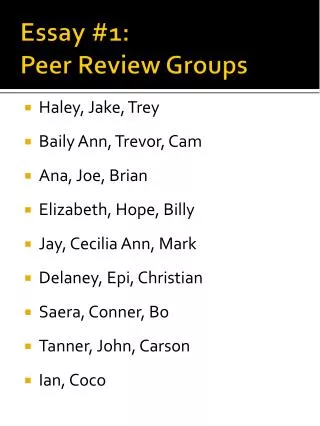
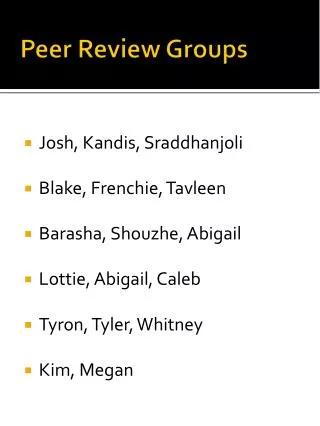
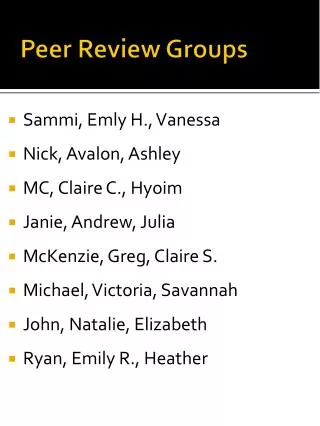
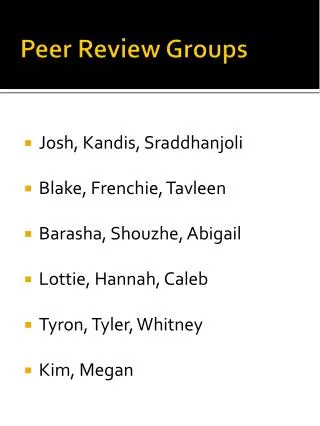
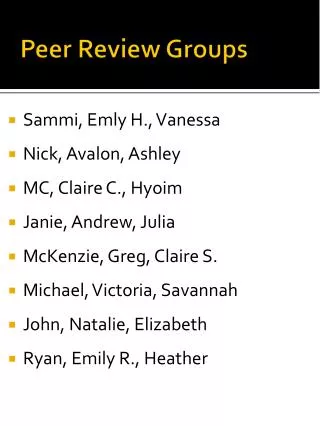
Peer Review Groups • Sammi, Emly H., Vanessa • Nick, Avalon, Ashley • MC, Claire C., Hyoim • Janie, Andrew, Julia • McKenzie, Greg, Claire S. • Michael, Victoria, Savannah • John, Natalie, Elizabeth • Ryan, Emily R., Heather
Peer Review/Self-Revision: Areas of Focus • Title— • Does it accurately indicate your topic/act as a guide? • If you read it in a Table of Contents, would you have a good idea of what the paper is about? • Are the primary texts covered included in the title?
Peer Review/Self-Revision: Areas of Focus • Introductory Paragraph(s)— • Do they hook you a reader? • Do they add insight to the paper topic as a whole? • Is it clear from these initial paragraphs where the paper is going?
Peer Review/Self-Revision: Areas of Focus • Thesis— • Is the central question(s)/claim(s) of the paper evident AND compelling? • Are the primary texts integrated into the thesis statement?
Peer Review/Self-Revision: Areas of Focus • Use of textual evidence— • Are their claims that are not supported by the text? • Are the quotes properly cited? • Are there quotes you believe the author could use to support his/her claims, which are not currently in the paper?
Peer Review/Self-Revision: Areas of Focus • Structure— • Does the order support the argument? • Does it flow (i.e. allow you to get lost while reading)? • If the essay is braided, does it follow a regular pattern?
Peer Review/Self-Revision: Areas of Focus • Overall quality of language • Any repeated words or ideas? • Any extraneous verbiage? • Are there transitions— • From paragraph to paragraph? • From sentence to sentence? • From one idea to the next?
Try not to write like this: From “If Everyone Still Wrote Like They Did in College,” collegehumor.com
Peer Review/Self-Revision: Areas of Focus • Conclusion— • Does the essay leave you with something to think about? • Is it clear how more is gained by comparing looking at both texts instead of simply considering one text on its own?
Homework • The final draft of Essay #2 is due to my Dropbox account by no later than midnight on Monday, 5/5. • TONIGHT: Eat food and watch a movie.